

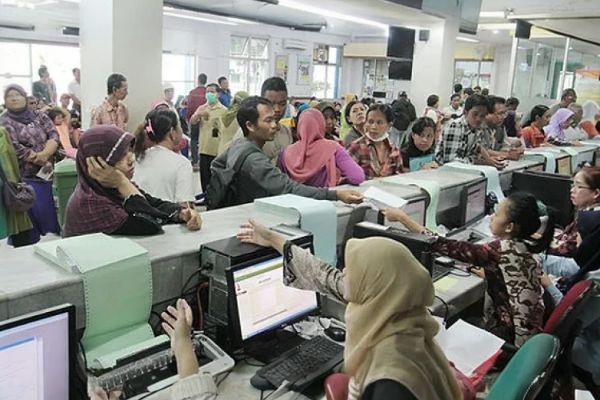
On July 22, 2026, a message appeared on Threads from inside a crowded Indonesian emergency room.
Yurizal Tri Chaerawan, an employee of a wedding organizer in Bogor, West Java, had been waiting eight hours for a hospital bed while suffering from a serious medical condition. Exhausted and apparently desperate for help, he wrote: “8 jam belum dapat ruangan. Gamau spill RS-nya, soalnya gue pake BPJS.” (“Eight hours and I still haven’t got a room. I don’t want to reveal the hospital because I use BPJS.”).
The sentence exposed an uncomfortable truth about Indonesia’s universal health insurance system. BPJS Kesehatan has transformed access to financial protection for millions, but an insurance card cannot create a hospital bed, summon an absent specialist or make an overcrowded emergency department move faster.
Yurizal’s plea was followed by something even more disturbing. Instead of receiving solidarity, he was reportedly mocked online by people identifying themselves as doctors, medical residents and hospital personnel. Some ridiculed his profile picture and accused him of seeking attention. Others joked that if he wanted a room quickly, the morgue was always available.
Yurizal reportedly read the comments, broke down in tears and eventually put his phone on airplane mode.
Nine days later, on July 31, he died.
The subsequent punishment of those accused of humiliating him was necessary. But treating the episode simply as a story of online cruelty or individual professional misconduct misses the larger pathology.
The more important question is why a health system can leave a seriously ill patient waiting eight hours while simultaneously placing its own doctors, residents and nurses under extraordinary institutional pressure.
That question leads beyond Threads. It leads to the architecture of Indonesian healthcare itself.
One of the most consequential changes to that architecture occurred before President Prabowo Subianto took office. The Health Law, Law No. 17/2023, removed the mandatory health-spending floors contained in the previous Law No. 36/2009. Under the old framework, the central government was required to allocate at least 5 percent of the state budget to health, excluding salaries, while regional governments were required to allocate at least 10 percent of their budgets.
The reform was intended to provide greater flexibility and allow health spending to respond to changing priorities rather than rigid legal formulas. In principle, that is defensible. In practice, flexibility creates a political risk: healthcare must now compete every year with highly visible presidential programs, infrastructure projects, defense priorities and other national ambitions.
The issue is not simply whether Indonesia spends enough, but also whether healthcare has sufficient institutional protection to receive the predictable, long-term investment required to build capacity.
The 2026 budget captures the paradox. The government has allocated approximately Rp 244 trillion to health, financing insurance, hospital development, disease control, nutrition and other priorities. That is an enormous sum. Yet Indonesia is also a country of more than 280 million people, thousands of islands and profound disparities in medical infrastructure and personnel.
The central challenge is system design, not just expenditure, and the most revealing weakness is the shortage of people.
According to the World Health Organization, only 78.1 percent of Indonesia’s public hospitals have the full complement of seven basic medical specialist categories. At the primary-care level, only 65 percent of puskesmas (health community center at the district level) meet the minimum requirement for nine basic categories of health workers.
The Health Ministry estimates that Indonesia could face a shortage of approximately 65,000 specialists by 2032. The problem is particularly acute outside major urban centers. Indonesia produces too few specialists, and are disproportionately concentrated in Java and other major population centers.
The government has begun reforming specialist education, including improving compensation and allowing residency programs to function more explicitly as professional employment. These are important steps. But the underlying problem remains. A system cannot indefinitely depend on exhausted residents, understaffed wards and overstretched nurses to compensate for structural shortages.
Burnout does not excuse cruelty. Nor does professional exhaustion absolve anyone of responsibility for humiliating a vulnerable patient. But burnout is an institutional warning.
When clinicians are chronically overworked, under-resourced and financially insecure, the consequences can extend beyond fatigue into cynicism, disengagement and a diminished capacity for empathy.
Punishing individuals after a scandal is therefore necessary but insufficient. The machine itself must be repaired.
A functioning health system requires a chain of care: community clinics capable of stabilization, district hospitals capable of emergency intervention, hospitals in the regions capable of advanced treatment and specialist centers capable of handling complex cases. Break one link and the entire chain becomes fragile.
Patients experience this structural failure not as policy statistics but as an ambulance journey, an unavailable specialist, a full ward or an eight-hour wait. Yurizal’s experience belongs to this larger pattern.
This is where Indonesia’s budget priorities become unavoidable.
President Prabowo has made the Free Nutritious Meals program, or MBG, one of his administration’s signature initiatives. The 2026 program was initially assigned Rp 335 trillion, although by July the government had revised the operational allocation to approximately Rp 229 trillion while seeking to reduce beneficiaries and improve efficiency and food safety.
The issue is not that feeding children is wasteful. Nutrition is healthcare. Preventing childhood malnutrition can produce enormous long-term benefits.
The problem is whether such programs are being developed as part of an integrated health strategy, or as politically visible projects operating alongside a health system that remains structurally weak.
Indonesia cannot sustainably address malnutrition while leaving the hospitals, specialists, nurses, emergency departments and primary-care networks responsible for diagnosing and treating vulnerable children underdeveloped. Every rupiah committed to one national priority is a rupiah that cannot simultaneously be spent elsewhere.
The more serious question is therefore what even a fraction of politically discretionary spending could accomplish if redirected toward durable health capacity. The answer is potentially transformative.
Indonesia should measure national healthcare performance not by meals distributed or buildings inaugurated, but by emergency waiting times, specialist availability, hospital occupancy, maternal mortality, cancer survival, stroke-treatment times, rural staffing and BPJS claim liquidity.
And the most important healthcare infrastructure is not concrete. It is people. Indonesia needs more doctors, but also more nurses, pharmacists, laboratory technologists, radiographers, midwives, emergency personnel and trained administrators.
That requires a long-term workforce compact: publicly supported specialist education, dignified resident compensation, transparent training environments, competitive rural salaries, housing and family incentives for remote postings, and credible career paths for clinicians who serve outside Java.
It also requires strengthening BPJS. Indonesia’s national insurance system has succeeded in making healthcare an entitlement rather than a privilege for millions. But insurance without adequate providers can create an illusion of universal access.
A BPJS card cannot manufacture a hospital bed nor create an intensive-care unit. It cannot make an exhausted nurse work another twelve hours without consequences. Coverage is the front door. Capacity is the house.
There is a temptation to remember Yurizal’s story as an isolated tragedy: a sick patient, an overcrowded hospital, a cruel online conversation and a death.
The disturbing feature of the case, however, is how many forms of institutional failure converged around one vulnerable human being: the patient became a burden; the resident became cheap labor; the nurse became an exhausted functionary; the hospital became an overcrowded institution; and the doctor became a professional trapped inside a system demanding more than it supplied.
The real test of Indonesian healthcare policy is whether the next Yurizal reaches a hospital where a bed is available, a specialist is present, a nurse has time to listen, a resident is rested enough to think clearly and a financing system is strong enough that treatment does not depend on administrative improvisation.
Indonesia does not lack money, medical talent or ambitious national programs. What it lacks is sufficient integration between them.
The tragedy of Yurizal should therefore not be remembered simply as the story of a cruel comment section. It should be remembered as a warning about what happens when a country measures healthcare by expenditure, insurance enrollment and political announcements while failing to measure the thing that matters most: whether a sick human being can get the care he needs when he needs it.
That is the real cost of a system that has learned how to spend, but has not yet fully learned how to build capacity.
