

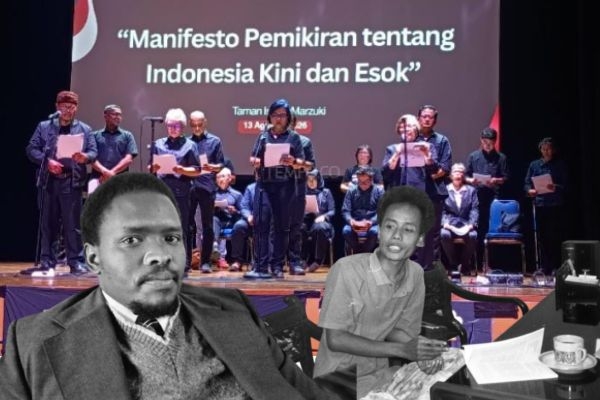
It was the height of the South African Apartheid regime in September 1977, and young South African intellectual and leader Stephen Biko was brutally tortured and murdered by the police when in detention. While voices of protest started to rise, it was generally thought the regime was simply too monolithic, too militarized to fall.
Enraged by the tragedy, musician Peter Gabriel, ex-Genesis frontman, penned the haunting anthem “Biko” to move the world, releasing it in 1980. It was among the first global artistic weapons deployed against the apartheid apparatus.
It stirred the world into active solidarity, rallying millions to look forward, never back, until the regime finally crumbled. As Gabriel powerfully put it in “Biko”:
“You can blow out a candle, but you can’t blow out a fire.
Once the flame begins to catch, the wind will blow it higher.”
Sixteen years later, in Indonesia, Wiji Thukul penned his most legendary poem, Peringatan, whose rallying cry: “Hanya ada satu kata: Lawan” (There is only one word: Resist!), ignited a flame of resistance against Soeharto’s military-led New Order regime, which ultimately crumbled.
Fast forward to mid-August 2026 in Jakarta. A parallel fire is beginning to catch. Confronted by growing anxieties over state direction, an independent coalition of the country’s prominent academics, professors, and activists gathered under the banner of Forum Intelektual Antardisiplin (FIAD).
On August 13, 2026, just a day before President Prabowo Subianto’s state address, FIAD issued a sharp, historic manifesto rejecting the un-democratic programs, policies, and creeping militarization of public space under the current administration.
The hope, much like the message embedded in Gabriel’s song, is that this small fire of academic and moral resistance will grow too big to be extinguished. That is precisely what academics like Prof. Sulistyowati Irianto, Prof. Premana Permadi, Prof. Manneke Budiman and Prof. Theddeus Prasetyono along with public intellectuals, like Okky Madasari, and activists, like Usman Hamid and Asfinawati, as well as other leading minds across Indonesian universities, are aiming to achieve.
They are stepping out of their comfortable lecture halls to draw a line in the sand against a terrifyingly familiar shadow: the resurgence of militaristic impulse over civil society.
For Indonesians, the trauma of unchecked militarism is not an abstract theory found in textbooks; it is written in blood. The history of the nation’s democratic struggle is anchored by ghosts that refuse to be silenced.
We remember Wiji Thukul, the courageous poet whose verses shook the New Order, who was abducted in the twilight of the regime and remains missing to this day. We remember Munir Said Thalib, the tireless human rights defender poisoned in mid-air in 2004 because he dared to pull back the curtain on military abuses.
Yet, the threat is not confined to the past. It wears a modern armor. The chilling continuum of state violence struck home vividly just a year ago, on August 28, 2025, when a 21-year-old online motorcycle taxi driver named Affan Kurniawan was run over and killed by a police tactical vehicle during a public protest in Jakarta. Affan’s death became a flashpoint, a brutal reminder that when public spaces are militarized and dissent is treated as a battleground, it is ordinary citizens who pay the ultimate price.
To those who believe that challenging a deeply entrenched, highly securitized administration is an exercise in futility, history offers a definitive rebuke. Indonesia itself holds the blueprint for how seemingly indestructible autocracies fall. For over three decades, President Suharto’s New Order regime operated as an all-powerful, omnipresent military machine. It controlled the economy, co-opted the judiciary, and used the brutal dwifungsi (dual-function) doctrine to place military officers in every layer of public and political life. Dissent was met with enforced disappearances, and the regime appeared utterly invincible.
Yet, when the economic match was struck in 1997, it was the moral clarity of intellectuals, the unyielding courage of university students, and the collective fury of regular citizens that shattered that monolith. The New Order did not collapse from a military coup; it crumbled because a unified population engaged in relentless “people power,” occupying the parliament and rendering the dictator’s vast security apparatus completely useless. When the masses lose their fear, the armor of the state dissolves.
What makes the 2026 FIAD manifesto distinct is that it moves beyond mere academic lamentation. It provides a concrete, multi-layered counter-strategy to dismantle the current autocracy.
Recognizing that the Prabowo government relies heavily on a “boiling frog” method of incremental, legalistic autocracy, the intellectuals have responded with a structured doctrine of resistance. They have mapped out 17 distinct sectors, ranging from higher education and the environment to the judiciary, where the executive branch is systematically concentrating power.
To counter this, FIAD’s strategy operates on three horizons of change. The First Horizon (Immediate Rescue): The primary focus is the immediate halt of institutional degradation. It explicitly demands a 12-month moratorium for the government to stop the systematic dismantling of democratic norms. This includes demanding the restoration of campus autonomy. The administration has weaponized higher education by forcing universities to act as echo chambers for state policies, a subtle form of intellectual conscription that suppresses free speech.
The Second Horizon (Institutional Reform): This tactic shifts from immediate containment to rebuilding the capacity of independent state agencies. It targets the judiciary and anti-corruption bodies, aiming to purge them of political cronyism and conflicts of interest.
The Third Horizon (Constitutional Transformation): The final horizon looks toward a 21st-century Indonesia anchored by social justice, ecological sustainability, and science-driven policymaking, ensuring that the state functions for the welfare of the people rather than the survival of a political dynasty.
This strategic framework directly confronts the core currency of the current administration: symbolic populism. The administration has used roaring, nationalistic speeches to project an illusion of economic sovereignty and strongman stability. However, these thunderous declarations serve as a distraction from structural violence.
Whether it is the expansion of controversial National Strategic Projects (PSN) that forcibly displace indigenous communities, or the fatal deployment of tactical armor on city streets, the fiery rhetoric masks a fragile democratic reality. The FIAD manifesto systematically strips away this populism, exposing it as a calculated tool to build legitimacy for a deeply compromised system.
Ultimately, the manifesto reminds us that a simple change in leadership is a superficial fix as merely replacing the figurehead at the top does not cure a broken democracy.
True Reformasi requires a complete overhaul of the state’s governance model. By unifying 87 prominent scholars, cultural figures, and legal experts into an organized front, FIAD is successfully building an intellectual infrastructure designed to outlast any single presidential term.
By tying the historic manifestos of today to the historic fall of Suharto, and to the sacrifices of Wiji Thukul, Munir, and Affan, the FIAD intellectuals are reminding the Prabowo government that Indonesia’s hard-won Reformasi cannot be rolled back quietly. The shrinking of democratic spaces and the weakening of campus autonomy are being met with the one thing authoritarian minds fear most: organized, unyielding reason.
The regime may seem too entrenched, the security apparatus too vast, and the populism too loud. But history has proven, from the cell blocks of Pretoria to the streets of Jakarta, that brute force is no match for the conscience of a nation. The intellectuals have struck the match.
As the truth of their manifesto spreads across campuses and communities, the wind is beginning to blow. And the flame will only catch higher.
