

There is probably no program in Indonesia’s history that better demonstrates the triumph of incompetence over common sense than MBG, President Prabowo’s beloved Free Nutritious Meals program.
Southeast Asia’s largest economy has been sliding into kakistocracy since Joko Widodo’s decade in power. Under President Prabowo Subianto, however, things have become increasingly surreal. Program after program, speech after speech, the line between government policy and political comedy has become increasingly difficult to see.
Let’s say it clear and loud : like Prabowo’s speeches, MBG is a dangerous joke. And this joke would be much funnier if children, thousands of them, were not getting poisoned.
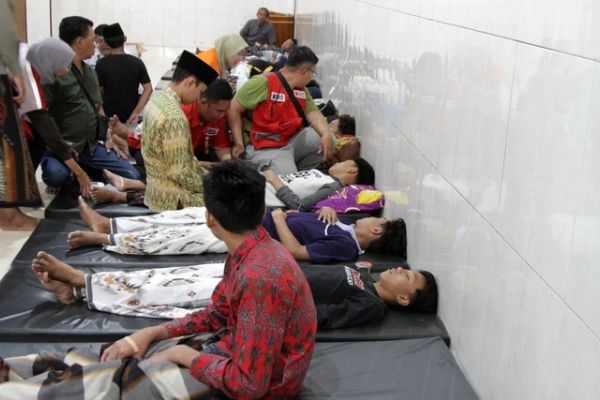
More than 2,000 students have reportedly been affected by suspected food poisoning in MBG incidents across Indonesia in the past week alone. This is not an isolated accident. It is another episode in a series of similar incidents since the programme began.
But don’t worry. The government has a solution. It will find someone to blame. A kitchen. A supplier. An operator. Somebody who cooked too early. Somebody who stored the food incorrectly. Somebody who failed to follow an SOP.
And then, naturally, there will be another SOP. This is how the current Indonesian bureaucracy solves problems: when reality refuses to cooperate with the design, produce a new regulation.
But perhaps we should stop asking who made the mistake and ask a slightly more annoying question: What if the mistake is the design itself?
MBG was built around SPPGs, kitchens expected to produce thousands of meals a day. The idea is perfectly rational if you are running a food business. Produce more. Spread your fixed costs. Reduce the cost per portion. Standardise production. Achieve economies of scale. Wonderful.
There is only one small problem. Children are not economies of scale.
A public nutrition programme should begin with the question of where malnourished and vulnerable children are and how to reach them safely. A business begins with a rather different question: how many meals can I produce efficiently?
Indonesia’s geography makes the distinction crucially important.
In a densely populated area, one large kitchen serving thousands of children may be efficient. In a remote village in Papua, Maluku or Nusa Tenggara, where schools are small and scattered and roads can be terrible, the same model can become an exercise in logistics worthy of a military campaign.
And there is an amusing irony here. The children who are easiest to reach are also the easiest to serve profitably. The children who are hardest to reach are often those most in need.
So what does a system based on scale naturally prefer? It prefers density. It prefers roads. It prefers markets. It prefers places where thousands of portions can be produced and delivered without too much trouble.
In other words, it tends to prefer the places where government intervention is easiest. Which is not necessarily where government intervention is most needed.
Then comes the food itself. Food, unlike speeches, has an unfortunate habit of deteriorating with time.
Thousands of meals must be procured, prepared, cooked, packed, transported and distributed before children can eat them. The longer and more complicated that chain becomes, the more opportunities there are for something to go wrong.
This is why the government now talks about strict limits between preparation and consumption. Fair enough. But perhaps there is a simpler solution than constantly reminding thousands of kitchens to behave perfectly.
Don’t make the food travel so far in the first place. The problem is not that SOPs are unnecessary. The problem is the belief that enough SOPs can make a fundamentally complicated system behave like a simple one. Well, they can’t.
And then there is food waste. A meal can be counted as successfully delivered even when it is cold, late, unappetising or simply not eaten. The spreadsheet celebrates. The child doesn’t.
This brings us to the most interesting question of all: why does MBG need to be such a gigantic machine? A programme of this size creates a very large economic ecosystem: kitchens, food suppliers, equipment, transportation, construction, procurement and countless other contracts.
Again, this does not mean that everyone involved is corrupt. It means something more basic. Where there is enormous public spending, there will be enormous opportunities for rent-seeking. The larger the machine, the more interesting the question of who benefits from keeping it running.
And once a bureaucracy has been created to manage a program of extraordinary size, another perfectly human thing happens: the bureaucracy becomes rather fond of having a programme of extraordinary size.
This is not uniquely Indonesian. Bureaucracies everywhere have discovered that there is little institutional advantage in successfully solving a problem if solving it means eliminating one’s own reason for existence.
Which brings us to the obvious alternative. For remote communities, why not make the program smaller rather than larger? Give funds directly to accountable village organisations, women’s groups and cooperatives. Let them buy local food and prepare it close to the children. Keep national nutritional standards. Keep food-safety requirements. Audit the money. Publish the procurement. Punish abuse.
It would not be perfect. Nothing involving public money ever is. But it could be cheaper in some places, fresher, more local and far better suited to communities that cannot possibly fit the economics of a giant central kitchen.
Most importantly, it would reverse the logic of MBG. Instead of asking how to make the kitchen more efficient, we would ask how to make the child better nourished.
That sounds almost revolutionary. Perhaps it is. Because MBG’s greatest problem may not be that it is too expensive, too centralised or too prone to food poisoning. Its greatest problem may be that somewhere along the way, the kitchen became more important than the child.
And that would be funny, if it weren’t so dangerous.
The Prabowo government likes big numbers. Bigger budgets. Bigger programmes. Bigger targets. Bigger promises. MBG fits perfectly into that political aesthetic.
But feeding children is not a competition to see how many meals a government can produce. The real measure is much less impressive: Are children healthier? Are the poorest reached? Is the food safe? Is the money producing nutrition rather than merely activity?
If those questions are inconvenient, perhaps we should ask them even more loudly. Because after thousands of children have been poisoned, saying that someone failed to follow the rules is no longer an explanation. It is a punchline.
And when the punchline keeps repeating itself, perhaps the joke is no longer the kitchen. Perhaps the joke is the system.
