

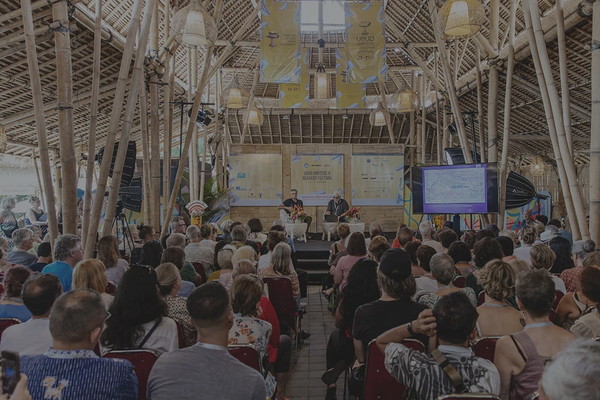
Organizing a literary festival is never easy, because it’s the least commercial of all festivals. Holding it consistently for several years in a row is rare anywhere in the world. And organizing it for more than 20 consecutive years in a country like Indonesia, with limited arts funding, unpredictable politics, and fragile infrastructure, is almost impossible. But that’s exactly what Janet De Neefe and her team have achieved with the Ubud Writers and Readers Festival (UWRF): doing the impossible.
Now entering its 22nd year, the UWRF returns to Bali from 29 October to 2 November 2025, carrying the theme Aham Brahmāsmi, or I Am the Universe, drawn from an ancient Sanskrit concept about the unity between the self and the cosmos. For Janet, the founder who began the festival in the aftermath of the 2002 Bali bombings as an act of healing and dialogue, the theme could not be more fitting. It captures the festival’s evolution, from a local cultural response to tragedy into one of Asia’s most enduring spaces for literary and philosophical exchange.
Two decades in, UWRF stands as one of the world’s longest-running literary festivals in the Global South. Each year it draws more than 250 speakers from over 20 countries, hosting around 200 events across Ubud’s cafes, courtyards, and art spaces. What began as an experiment in cultural diplomacy has become a global meeting ground for writers, activists, artists, and readers, all converging in a small Balinese town best known for its lush terraced hills and spiritual energy.
But the real story of UWRF is not its scale or glamour. It is the festival’s stubborn persistence: its refusal to fade in a region where arts initiatives rarely last beyond a few cycles of funding or political fashion. The festival’s survival is itself an act of imagination: a statement that stories still matter in an age of algorithms and crisis.
A Platform for Voices That Challenge Power
This year’s edition reaffirms UWRF’s commitment to literature as resistance, as a language of conscience and change. Among the most anticipated sessions is Indonesian novelist and activist Okky Madasari, known for her sharp social critiques of authoritarianism, gender inequality, and the erosion of civic freedoms.
In an age where Southeast Asia’s democracies are increasingly strained, Okky’s participation stands out as both literary and political. Her novels and essays dissect the contradictions of modern Indonesia, a democracy flirting with authoritarian nostalgia, while insisting that literature remains a moral compass.
At UWRF 2025, Okky will appear in several key sessions exploring freedom of expression, digital culture, and the future of the written word in the AI era. For international visitors, her presence offers a glimpse into Indonesia’s most fearless literary mind; for local audiences, it’s a reminder that literature can still provoke, question, and defend.
If past years focused on memory and postcolonial identity, this year’s program widens the lens. Panels and workshops explore the intersections of ecology, cosmology, and consciousness, tracing how traditional and indigenous knowledge systems can coexist with modern anxieties about climate collapse and digital alienation.
The festival’s main theme, I Am the Universe, acts as both meditation and provocation: What does it mean to be connected in a fragmented world? What is the writer’s role when borders harden and truths blur?
Speakers this year include Jenny Erpenbeck, the 2024 International Booker Prize winner for Kairos, and Banu Mushtaq, the 2025 Booker laureate for Heart Lamp, alongside Pico Iyer, whose essays on travel and stillness have long defined global introspection. Together they bring the weight of world literature into conversation with local realities.
Yet the festival never forgets its roots. Local and regional authors, from Ratih Kumala to emerging Papuan writers featured in the “Where the Land Knows My Name” panel, remind audiences that Southeast Asia’s literary frontier is not merely growing; it is reshaping the world’s narrative imagination.
Beyond the Page: Activism, Ecology, and Translation
Over the years, UWRF has expanded its identity beyond books. It is now a hub for ecological thought, activism, and translation, a living ecosystem of ideas. The 2025 program features climate-focused panels, indigenous storytelling circles, and workshops on sustainable publishing. The conversation around literature’s role in the age of environmental collapse feels particularly urgent in Bali, where the island’s natural beauty has long been both muse and victim.
A standout initiative this year is the Emerging Writers Program, which supports young voices from across the archipelago, culminating in a bilingual anthology published in collaboration with Penguin Random House SEA. The program underlines UWRF’s growing emphasis on translation, not just linguistic, but cultural, bridging the archipelago’s dozens of languages with English and global readerships.
Translation, after all, is the lifeblood of Southeast Asian literature. It allows a story from Papua, Aceh, or Surabaya to resonate in Sydney or Stockholm, and positions UWRF as one of the few platforms actively nurturing that cross-pollination.
Ubud itself remains an integral part of the experience. Beyond the festival tents and discussion halls, conversations spill into rice fields, yoga studios, late-night bars, and bookshops tucked behind banyan trees. Writers are spotted scribbling notes over coffee at Seniman or walking barefoot to sessions under the morning mist.
This geography of intimacy, the closeness between readers and writers, is what separates UWRF from the big-budget festivals of the global North. Here, literature is not distant or institutional. It breathes, sweats, and mingles with the tropical air.
Why It Matters, and Why It Endures
In a time when the publishing industry is under strain, and when Southeast Asia is wrestling with censorship, fake news, and shrinking civic space, UWRF remains a rare, defiant act. It insists that ideas can still travel freely, that empathy, imagination, and dialogue can cross the borders politics builds.
Its endurance also proves something profound: that a literary festival can be both local and universal, rooted in Ubud but reaching for the cosmos. De Neefe’s original mission, to heal through storytelling, continues to evolve, showing that art can survive beyond markets and metrics.
For Indonesia, the festival has helped situate its writers on the world map. For the region, it offers a shared cultural stage, a Southeast Asian narrative space where ideas transcend nationalism. And for the world, it stands as a reminder that literature’s purpose is not just entertainment but enlightenment.
“I Am the Universe” is more than a theme. It’s a declaration that stories hold together what politics divides, that the personal, the planetary, and the poetic are all bound in the same orbit.
For readers, the 2025 Ubud Writers & Readers Festival offers more than a program; it offers perspective, a space to listen, to argue, to imagine. And for Indonesia, it reaffirms that even amid inequality and chaos, words still carry the power to connect the universe within us all.
Omong-Omong Media is an official media partner of Ubud Writers and Readers Festival 2025
