

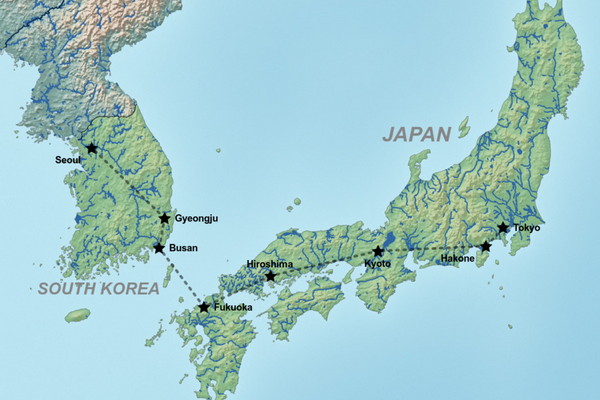
As President Prabowo Subianto departs for Japan and South Korea this weekend, he should be reminded why these two East Asian nations, both lacking natural resources and emerging from the ruins of war, have succeeded in becoming far more developed than Indonesia, despite starting from a far worse position.
This is not a story about culture, nor about luck. It is a story about power, who controls it, how it is exercised, and whether it serves the public or protects itself.
In the early 1960s, Indonesia was not destined to fall behind. It had abundant natural resources, a large population and strategic geography. South Korea, by contrast, was one of the poorest countries in the world, devastated by war, with little to export but labor. Japan was still rebuilding from total destruction.
Yet today, South Korea’s GDP per capita stands at around $36,000 to $37,000. Japan’s remains above $35,000. Indonesia is still hovering around $5,000, struggling to escape the middle-income trap.
The gap is not just economic. It is structural, institutional and, above all, political.
Japan and South Korea built strong states, not merely in the sense of authority, but in their ability to discipline power. They created industrial giants, but they did not surrender to them. In Japan, bureaucrats at the Ministry of International Trade and Industry set the direction of industrial policy with long-term vision. In South Korea, the state under Park Chung-hee forced conglomerates, the chaebol, to meet strict export and productivity targets. Those who failed lost access to credit, protection and privilege.
Power, in these systems, was not free-floating. It was controlled, negotiated and, when necessary, punished.
South Korea offers the most striking example. Its presidents have gone to prison. Its corporate leaders have been prosecuted. The message, however imperfectly applied, is clear: no one is entirely beyond reach. This is not the absence of oligarchy. It is the containment of it.
Indonesia tells a different story.
Here, power and wealth have long been intertwined in ways that are difficult to disentangle. The fall of authoritarianism in 1998 promised reform, but it did not dismantle the underlying structure. Instead, it reshaped it. Political power became more competitive, but economic power remained concentrated. The result is a system in which influence flows not only through institutions, but through networks, often opaque, often unaccountable.
Today, that pattern is not disappearing. It is evolving.
Recent moves by the Prabowo government, reclaiming millions of hectares of land, tightening control over natural resources, pursuing high-profile legal cases, have been presented as signs of stronger governance. On the surface, they may look like long-overdue efforts to restore order and enforce the law.
But beneath that surface lies a more troubling question: who is being disciplined, and who is not?
This question matters because Indonesia is not simply dealing with economic policy. It is dealing with the concentration of power across sectors that define its future.
Consider the expanding reach of business networks closely connected to political authority. From forests and carbon markets to mining, plantations and large-scale infrastructure, economic influence is already deeply embedded in the country’s most strategic sectors. Now, that reach is extending further, into the digital economy, into artificial intelligence, into the infrastructures that will shape how knowledge, data and capital circulate in the decades to come.
This is consolidation, not diversification.
When economic power stretches from land to energy to technology, and when it operates in proximity to political authority, the risks multiply. Policies that should serve the public interest can become aligned, subtly or overtly, with private advantage. Regulatory decisions can shape not just markets, but the distribution of opportunity itself.
In such a system, the language of reform becomes slippery.
Reclaiming land can mean restoring environmental balance, or it can mean redistributing control. Promoting a green economy can mean sustainability, or it can mean repackaging extraction under a new label. Investing in digital transformation can mean expanding access, or it can mean concentrating it.
The question is not what policies are called. The question is who benefits from them.
Japan and South Korea faced similar tensions in their own development. They, too, had powerful business groups. They, too, risked capture. But they developed mechanisms, imperfect, contested, but real, to impose discipline. Their states did not always act justly, but they acted with a clear understanding that unchecked power, whether political or economic, would ultimately undermine national development.
Indonesia has yet to make that choice.
Its economy remains heavily reliant on natural resources, sectors that generate wealth but do not necessarily produce the technological advancement needed for long-term competitiveness. Its investment in research and development remains below around 0.3 percent of GDP, far behind South Korea’s 4–5 percent. Its global corporate presence is limited compared to the technological giants of East Asia. And its inequality, reflected in a Gini coefficient hovering around 0.38–0.40, continues to reveal deep imbalances in access to wealth and opportunity.
But beyond the numbers lies something more intangible, and more dangerous: fear.
Fear is not only the fear of violence or repression. It is the fear that speaking out carries consequences. The fear that challenging power is futile. The fear that the rules are not applied equally, that accountability is selective, that justice depends on proximity to authority.
This is where economic and political structures meet. Because without trust in institutions, without confidence that power can be questioned and held accountable, development becomes fragile. Growth may continue, but it will not be inclusive. Innovation may emerge, but it will not be widely shared. Stability may appear, but it will be built on uncertainty.
Japan and South Korea did not eliminate fear. But they reduced its reach within their economic systems by strengthening institutions, enforcing rules and, crucially, demonstrating that power could be checked.
Indonesia must decide whether it is willing to do the same.
As President Prabowo Subianto engages with leaders in Tokyo and Seoul, the real lesson is not about attracting investment or signing agreements. It is about understanding that development is not simply a technical process. It is a political one.
It requires the courage to confront entrenched interests, the discipline to enforce rules consistently and the humility to recognize that power, if left unchecked, will serve itself before it serves the nation.
Indonesia has the resources, the talent and the potential to become a far more advanced economy. What it lacks is not capacity, but clarity, clarity about the kind of system it wants to build, and the kind of power it is willing to tolerate.
Until that question is answered, the country will continue to move forward, but never quite far enough.
And the gap between Indonesia and the nations it seeks to emulate will remain, not because it cannot be closed, but because it is not yet being confronted.
