

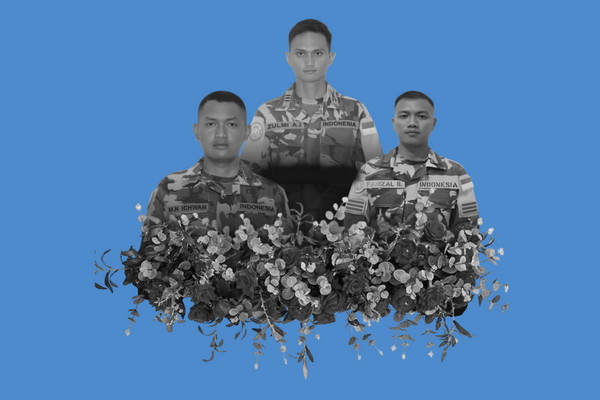
President Prabowo Subianto must immediately withdraw Indonesia from any initiative, forum or framework that involves Israel, especially the so-called Board of Peace formed by US President Donald Trump, as a direct response to the killing of Indonesian peacekeepers in Lebanon.
Anything less would signal that Indonesian lives can be taken without consequence, and that engagement can continue as if nothing has happened.
The deaths of three Indonesian soldiers serving under the United Nations Interim Force in Lebanon (UNIFIL) are not an abstract geopolitical event. They are a national tragedy, and also a political test.
These were not combatants. They were peacekeepers, sent by Indonesia to help stabilize a volatile region, to prevent escalation, and to uphold the very idea that international cooperation can restrain violence. Their presence in southern Lebanon represented Indonesia’s long-standing commitment to peacekeeping, one of the largest such contributions in the world.
Now, they are dead.
A Pattern That Cannot Be Ignored
As in so many previous incidents in the region, responsibility is being contested. Israel has suggested that Hezbollah may be responsible. Hezbollah has denied involvement. Competing narratives emerge almost instantly, each side seeking to shape the story before facts can fully surface.
But beyond these claims lies a pattern that is difficult to ignore.
The operational area of UNIFIL has been under sustained and intensified military pressure from the Israel Defense Forces. Airstrikes, artillery fire and ground operations have transformed large parts of southern Lebanon into a highly dangerous environment, not only for combatants, but for civilians and international personnel alike.
In such conditions, the question is not only who pulled the trigger. It is who created the circumstances in which the killing of peacekeepers became possible.
This is where the burden of responsibility cannot simply be deflected.
Israel’s defenders will argue that the fog of war makes attribution difficult, that Hezbollah operates within civilian areas, and that unintended casualties are an unfortunate reality of conflict.
But this argument has been made before, repeatedly, across decades of conflict.
From Lebanon to Gaza, a familiar sequence emerges: overwhelming force is deployed, civilians and non-combatants are caught in the aftermath, and responsibility becomes contested or diluted. Investigations are promised, explanations are offered, and yet the fundamental pattern remains unchanged.
For many in the Global South, including Indonesia, this is not merely a matter of military necessity. It is a question of credibility.
Can a state that repeatedly operates in ways that endanger civilians and international personnel still be trusted to uphold the norms it claims to respect?
The deaths of Indonesian peacekeepers make that question unavoidable.
Engagement Is Not Neutral
Indonesia has long prided itself on being a principled actor in international affairs. It has no formal diplomatic relations with Israel, maintaining a consistent position in support of Palestinian rights. At the same time, it has actively contributed to global peacekeeping missions, placing its soldiers in some of the world’s most dangerous environments in the name of stability and cooperation.
This dual position, principled distance combined with active engagement, has allowed Indonesia to maintain credibility both domestically and internationally.
But that balance now faces a serious challenge.
Because while Indonesia may not have formal ties with Israel, it is increasingly involved in multilateral frameworks in which Israel is a participant. These forms of engagement, however indirect, carry political meaning. They signal a willingness to coexist within shared platforms, to cooperate under certain conditions, and to move forward despite unresolved tensions.
After the killing of Indonesian peacekeepers, that position is no longer tenable.
There is a tendency in international diplomacy to treat engagement as inherently positive, to assume that dialogue, participation and cooperation are always preferable to isolation.
But engagement is not neutral.
It confers legitimacy. It signals acceptance. It suggests that, despite disagreements, the fundamental conditions for cooperation remain intact.
When Indonesian peacekeepers are killed in a conflict zone dominated by Israeli military operations, continuing engagement without protest sends a dangerous message: that such incidents do not fundamentally alter the relationship.
That message must be rejected.
Withdrawal from any initiative involving Israel would not be an abandonment of peace. It would be a reassertion of principle, that peace cannot be built on the normalization of actions that put international personnel at risk.
One of the most troubling aspects of incidents like this is the recurring gap between acknowledgment and accountability.
Statements are issued. Regret is expressed. Investigations may be promised. But rarely do these processes lead to clear, enforceable consequences.
This is not unique to Israel, but it is particularly visible in conflicts where power asymmetries are stark and geopolitical alliances shield certain actors from meaningful scrutiny.
For Indonesia, accepting this pattern would mean accepting a system in which the deaths of its citizens can be absorbed into a cycle of explanation without resolution.
That is not acceptable.
A Line That Must Be Drawn
Indonesia’s skepticism is not born in isolation. It is shaped by a long history of observing how power operates in international conflicts.
Time and again, narratives are constructed, contested and reshaped to serve strategic interests. Responsibility is often blurred, especially when it risks implicating powerful actors.
In such an environment, smaller and middle powers like Indonesia must rely not only on official accounts, but on patterns of behavior over time.
And those patterns matter.
They inform judgments about trust, about risk, and about the conditions under which cooperation remains possible.
Amid all the strategic calculations, it is easy to lose sight of what this incident represents at a human level.
Three Indonesian soldiers—peacekeepers—lost their lives while serving under the United Nations. They were not there to wage war. They were there to prevent it.
Their deaths are not collateral. They are a failure of the system that is supposed to protect those who come in the name of peace.
For their families, for their colleagues, and for the country they served, this is not a diplomatic issue. It is a loss that demands meaning.
President Prabowo now faces a clear choice.
He can treat this as an unfortunate but isolated incident, issue statements of concern, and allow Indonesia’s existing engagements to continue unchanged.
Or he can recognize it for what it is: a moment that requires a decisive response.
Withdrawing Indonesia from any framework that includes Israel, particularly those framed as “peace initiatives”, would send a clear and necessary signal. It would demonstrate that Indonesia does not accept a situation in which its citizens can be killed while cooperation proceeds as usual.
Such a move would not resolve the conflict in Lebanon. But it would restore a measure of integrity to Indonesia’s own position.
This is not only about Indonesia.
The safety of peacekeepers is a cornerstone of international cooperation. If UN personnel can no longer rely on basic protections, the entire system of peacekeeping is weakened.
Other countries will be watching how Indonesia responds. If one of the largest contributors to UN missions accepts such losses without meaningful action, it sets a precedent.
Silence, in this context, is not neutrality. It is a signal.
There are moments in internaional relations when ambiguity is no longer sustainable, when the cost of maintaining flexibility outweighs the benefits.
This is one of those moments.
The deaths of Indonesian peacekeepers in Lebanon should mark a line. Not a line drawn in anger, but one drawn in clarity.
Indonesia cannot continue any form of engagement with Israel as if nothing has happened.
To do so would not be pragmatism.
It would be a quiet acceptance that the lives of its peacekeepers are negotiable.
That is a message no country should send.
