

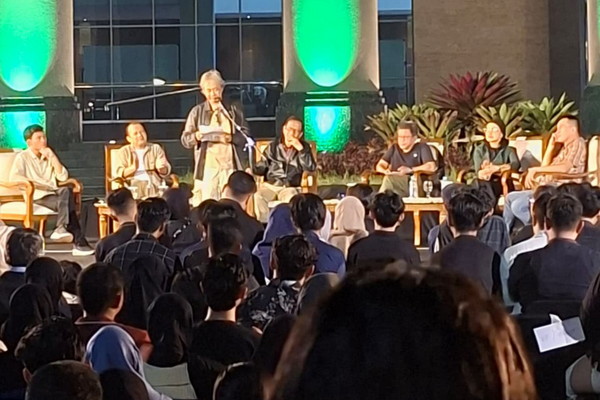
It was not just another ordinary night. It could well have been the beginning of something bigger, as concern and anger continue to grow exponentially toward President Prabowo Subianto, who, as The Economist recently asserted, is “jeopardising the nation’s economy and democracy” just two years into his reign.
More than 1,000 people, mostly young Indonesians, gathered that Tuesday evening in front of the Faculty of Law’s main building at the Indonesian Islamic University (UII) in Yogyakarta. They were fired up, cheering and applauding speeches, discussions, and poetry readings in an event meant to remind people not only of the death of the spirit of Reformasi, but also of the urgent need to reimagine resistance itself.
“Reformasi is dead, and we must start a totally new look and strategy to confront the challenges ahead,” proclaimed author and sociologist Okky Madasari, one of the speakers at the gathering.
Law Professor Mahfud MD lambasted the ruling elites as creating and using the law to protect their own corrupt acts. UII Rector Prof. Fathul Wahid read a poem describing Indonesia as a bus without brakes, a condition capable of endangering everyone inside it, while celebrity political commentator Rocky Gerung shouted for a “revolution” to replace what he called the now-dead Reformasi.
And if that evening was any indication, the feeling is beginning to spread nationwide.
Earlier this month, around 30 young Indonesians from across the archipelago gathered in a modest room in Condong Catur, Sleman, Yogyakarta. Most were in their twenties. Some were students, others community organizers, aspiring writers, labor activists, or content creators. They had come to attend what the organizer, the Social Movement Institute, called a “School of Politics.”
That morning, however, they were not discussing electoral systems or constitutional law. They were trying to write poetry. The participants were preparing for the possibility that one day they might read their poems during street protests.
For many Indonesians who came of age after Reformasi 1998, the scene might seem unusual. A generation raised amid social media metrics, short-form videos, and algorithmic politics was relearning an older language of resistance: storytelling, collective emotion, and public courage.
Yet perhaps this is precisely where Indonesia’s democratic resistance stands today, not dead, but searching for a new form.
This May marks 28 years since the fall of Suharto, brought down by one of the largest student-led mobilizations in modern Asian history. Reformasi promised democracy, civilian supremacy, and freedom from authoritarianism. It was not merely a change of government; it was imagined as the birth of a new political morality.
Nearly three decades later, however, that promise feels increasingly hollow.
When Resistance Becomes Part of Power
Many of the activists who once led the struggle now sit comfortably within the very structures they once opposed. Figures such as Budiman Sudjatmiko and Nezar Patria, once symbols of resistance, have become part of the political establishment. Others, including labor activist Jumhur Hidayat, have followed similarly complicated trajectories.
This has produced a familiar accusation among disappointed former activists and younger critics alike: betrayal.
But focusing solely on personal betrayal misses the deeper problem. Indonesia’s democratic resistance has not simply weakened; it has been absorbed. Reformasi did not falter merely because some of its actors lost their ideals. It struggled because the political and economic system they confronted proved remarkably capable of incorporating dissent into its own reproduction.
The result is a paradox. Indonesia today remains formally democratic, yet it is increasingly marked by the consolidation of elite power, shrinking civic space, dynastic politics, and the gradual return of militaristic tendencies. Reformasi changed the faces of power, but not necessarily its deeper structure.
This is why the question confronting Indonesia today is larger than whether certain individuals abandoned the movement. The more uncomfortable question is whether democratic resistance itself, as an independent political force, has ceased to exist in any meaningful sense.
The trajectory of post-1998 Indonesia reveals a pattern familiar in many democracies: movements that succeed in opening political space often struggle to transform the structures of power within that space.
Reformasi dismantled authoritarian rule, but it did not uproot the networks of oligarchic influence built during the New Order era. Political parties evolved into vehicles for elite consolidation rather than mass representation. Economic power remained concentrated among powerful business and political families. And the state developed new ways of managing dissent, not always through overt repression, but through incorporation.
Many former activists entered politics believing they could continue the struggle from within. Yet over time, participation demanded compromise, and compromise gradually became accommodation.
The French philosopher Michel Foucault once argued that modern power is often most effective not when it crushes resistance outright, but when it absorbs and redirects it. Indonesia’s post-Reformasi experience increasingly reflects this dynamic.
What Indonesia is witnessing today is not simply the decline of a movement, but its transformation into something less oppositional, less disruptive, and ultimately less capable of challenging entrenched power.
Democracy in the Age of Spectacle and Fear
At the same time, the social base that once sustained mass mobilization has fractured.
The student movement that drove Reformasi has become fragmented and politically inconsistent. Labor activism remains alive but divided. Much of civil society has become increasingly professionalized, operating through NGOs dependent on donor cycles rather than rooted mass constituencies. Activism has often shifted from long-term organizing toward issue-based advocacy and reactive campaigns.
The result is a paradoxical landscape: high visibility but limited transformative power.
The rise of digital politics has further complicated the situation. Social media has expanded access to political participation while simultaneously weakening organizational depth. Viral moments frequently replace sustained movements. Political engagement becomes performative, shaped by algorithms, outrage cycles, and fleeting attention spans.
One of Reformasi’s greatest achievements was the expansion of press freedom. After decades of state-controlled information under Suharto, independent media outlets mushroomed across the country, creating a vibrant and often chaotic democratic public sphere. Many of these platforms were small, financially precarious, and politically independent.
Yet over time, much of that freedom has also been gradually corrupted. Major media institutions have been absorbed into large business conglomerates or drawn into networks of political patronage and government influence. Even newer digital platforms increasingly face pressures of access, funding, and political alignment.
The recent announcement by M. Qodari, head of the Presidential Communication Office, that dozens of online media platforms had been consolidated into a so-called “New Media Forum” to strengthen government public communication reinforced concerns among critics that sections of Indonesia’s once-independent media ecosystem are being incorporated into state narrative management rather than functioning as democratic watchdogs.
The philosopher Jean Baudrillard warned of a political condition in which images become detached from reality, producing spectacles that substitute for substantive transformation. Indonesia increasingly risks entering precisely such a condition: a democracy full of noise, content, and symbolic participation, yet lacking organized social power capable of producing structural change.
Yet paradoxically, the current political moment may also contain the seeds of a new opposition.
Under Joko Widodo, democratic decline often unfolded through ambiguity. The language of reform, inclusion, infrastructure development, and technocratic progress coexisted with weakening institutions, oligarchic consolidation, and increasing restrictions on criticism. The boundaries between democratic governance and democratic erosion frequently appeared blurred.
Under Prabowo Subianto, however, the contours of power appear far more explicit. The growing role of military figures in civilian affairs, the centralization of authority, and increasingly open hostility toward critics have clarified what many activists see as the return of authoritarian tendencies.
Recent events have reinforced this perception. The acid attack against activist Andrie Yunus shocked many Indonesians not only because of its brutality, but because it deepened fears that intimidation against government critics is entering a more dangerous phase. The mass arrest of thousands of students during the large demonstrations at the end of August signaled a more aggressive approach toward street mobilization. The criminalization of prominent pollster Syaiful Mujani further strengthened concerns that critical voices are increasingly vulnerable to political targeting.
Taken individually, these incidents may appear disconnected. Together, however, they contribute to a growing public perception that coercion is becoming normalized within democratic life. For younger Indonesians who did not directly experience the authoritarianism of the New Order, such episodes are becoming formative political experiences of their own.
Paradoxically, this clarity may also create conditions for rebuilding solidarity. The creeping militarism and centralization visible today may unintentionally provide what fragmented civil society has lacked for years: a common political adversary.
Beyond Nostalgia: Rebuilding Democratic Resistance
But nostalgia for Reformasi alone will not revive Indonesian democracy. If Indonesia’s democratic resistance is to regain relevance, it must move beyond the assumptions and weaknesses of the 1998 generation.
First, movements must build institutions, not merely organize protests. Independent media platforms, community schools, cultural spaces, cooperatives, and alternative intellectual networks are essential for sustaining long-term resistance beyond electoral cycles and viral outrage.
Second, activists must rethink their relationship with power. Entering formal politics should be treated as a tactical engagement rather than a final destination. Without organizational accountability and independence, incorporation into elite networks becomes almost inevitable.
Third, movements must rebuild connections with workers, farmers, informal laborers, and economically vulnerable communities. Too much post-Reformasi activism became concentrated within urban middle-class networks disconnected from broader social realities.
Fourth, resistance must also be waged at the level of culture and narrative. In an era shaped by digital spectacle, literature, film, poetry, humor, and storytelling are not secondary to politics; they are central political battlegrounds. The struggle for democracy is increasingly a struggle over imagination itself.
Finally, Indonesian civil society must overcome one of the deepest weaknesses of the post-Reformasi era: the separation between activism and practical politics.
For too long, many movements limited themselves to moral critique while abandoning electoral contestation to oligarchic forces. This does not mean democratic movements should dissolve into political parties. But it does mean they must begin organizing strategically toward the 2029 elections: identifying credible democratic figures, building broad coalitions, and developing a shared political agenda capable of challenging authoritarian consolidation.
Without political organization, protest alone risks becoming symbolic performance.
The generation that toppled Suharto believed democracy would sustain itself once authoritarianism collapsed. Twenty-eight years later, Indonesia has learned a more difficult lesson: democratic institutions without organized social power are easily captured.
Yet the story may not end there.
In classrooms, labor communities, cultural spaces, and small gatherings like the one in Yogyakarta, a younger generation is beginning to search for new languages of resistance. They understand that political struggle today is fought not only in parliament or on social media, but also through memory, art, organization, and long-term institution-building.
Indonesia’s democratic resistance may no longer look like it did in 1998. Perhaps it should not.
But if Reformasi’s first generation exposed the possibility of democratic change, the next generation may yet learn how to defend it from co-optation, spectacle, and authoritarian return.
The question is no longer whether Indonesia’s democratic resistance is dead.
The question is what kind of resistance will rise in its place.
