

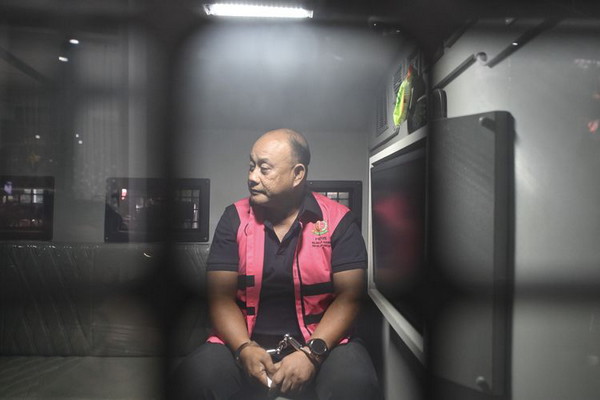
The arrest of Dadan Hindayana should have been a political earthquake.
As the head of the National Nutrition Agency (BGN), Dadan was not juts another bureaucrat. He was the public face of Makan Bergizi Gratis (MBG), President Prabowo Subianto’s flagship program and arguably the single most recognizable promise of his presidency.
Only months ago, he was assuring Indonesians that MBG was protected by sophisticated oversight systems and strict monitoring mechanisms. Today, he stands accused of corruption alongside other senior officials.
The government will likely present the arrests as proof that accountability works. Corrupt officials have been identified. Law enforcement has acted. The program continues.
But such a conclusion misses the larger story.
The Dadan scandal is not just a corruption scandal. It is a warning sign. It is the first major crack in a project that was already showing signs of strain long before prosecutors entered the picture.
The real question is not why corruption occurred.
The real question is why President Prabowo remains determined to continue and expand MBG despite growing evidence that the program is fiscally burdensome, administratively problematic, and politically vulnerable.
To answer that question, we need to stop looking at MBG as a nutrition program and start looking at it as a political project.
The scandal is not the story. The story is why the project survives.
For months, warning signs have accumulated. Reports of food poisoning have periodically emerged. Logistical problems have disrupted implementation. Questions have been raised about procurement, oversight, and coordination. Now corruption allegations have reached the very top of the agency tasked with running the program.
In most governments, such a sequence of events would trigger a fundamental reassessment.
Yet there is little indication that MBG will be significantly scaled back.
Why?
The answer cannot be nutrition alone.
If Indonesia’s sole objective were reducing malnutrition, there are far cheaper and more targeted ways to do so. The country could concentrate resources on districts with severe stunting, chronic poverty, and food insecurity. It could focus on remote regions where nutritional deficiencies remain acute. Such a strategy would cost a fraction of the current budget while arguably delivering more direct benefits.
Instead, MBG was designed as a massive universal program.
That choice reveals something important. MBG serves functions beyond nutrition.
The first is political identity.
Throughout the 2024 election campaign, no promise became more closely associated with Prabowo than free meals. Voters may struggle to recall details of industrial policy or fiscal reform. They remember MBG. It became the symbol of his candidacy and later the symbol of his presidency.
This matters because politicians rarely abandon the policies most closely associated with their political legitimacy.
Reducing MBG would not simply be a policy adjustment. It would be interpreted as an admission that the defining promise of the administration was flawed.
For any politician that would be difficult. For a politician whose public image is built on certainty, decisiveness, and strength, it may be politically unthinkable.
Yet political symbolism alone does not explain the persistence of MBG.
The second explanation lies in visibility.
Industrial policy is invisible. Research funding is invisible. Educational reform takes years before producing measurable results. Building technological capabilities can take decades.
School meals, by contrast, are immediately visible. Every day millions of children receive food. Every day millions of parents see the results. Every day photographs circulate across social media, television broadcasts, government reports, and political campaigns.
Few government programs create such direct and continuous contact between the state and ordinary citizens.
This is not just a feeding program. It is a political communication machine.
And perhaps the most effective one Indonesia has ever seen.
The timing makes the government’s commitment even more striking. Indonesia is entering a period of increasing economic pressure.
The rupiah has weakened dramatically and is now hovering near the psychologically significant Rp18,000-per-dollar threshold. Market analysts report persistent pressure on the currency, while investors have become increasingly concerned about fiscal conditions and policy credibility.
Trade surpluses, which helped cushion the economy during the commodity boom years, are showing signs of narrowing. Recent economic data indicate growing pressure from slowing exports, rising import costs, and a less favorable external environment.
Investor confidence has become more fragile. Bank Indonesia has been forced to intervene repeatedly to support the rupiah, while concerns regarding fiscal governance and policy direction have become increasingly prominent in financial markets.
This is precisely the moment when governments are normally expected to prioritize.
And that is where the debate over MBG becomes unavoidable.
Every rupiah spent on MBG is a rupiah unavailable for other priorities. Every trillion allocated to feeding programs is a trillion not allocated to strengthening manufacturing, upgrading vocational education, funding scientific research, improving teacher quality, supporting innovation, or building technological capabilities.
Indonesia’s greatest challenges today are not primarily nutritional. Indonesia’s greatest challenges are structural.
The country faces deindustrialization pressures. Productivity growth remains weak. Technological dependence persists. Educational quality remains low and uneven. Manufacturing competitiveness lags behind many regional rivals.
No country has escaped the middle-income trap by feeding itself into prosperity.
Countries escape the middle-income trap through productivity, innovation, industrial transformation, and educational excellence.
School feeding programs can complement those goals. But they cannot replace them.
The opportunity cost of MBG therefore deserves far more attention than the corruption scandal itself.
But there is a third explanation for why MBG continues: politics and power.
By 2029, MBG may become something much larger than a welfare program.
Consider the scale. Millions of children. Millions of parents. Thousands of schools. Thousands of suppliers. Thousands of local operators. Thousands of communities interacting with the program every single day.
No political campaign can match that reach. No advertising strategy can reproduce that level of sustained visibility. No presidential speech can generate that frequency of contact.
Whether intentionally designed for electoral purposes or not, MBG creates an extraordinary political asset.
A nationwide network of beneficiaries who experience the presence of the state on a daily basis.
This does not mean MBG exists solely to secure re-election. Such a claim would be difficult to prove.
But it does raise an obvious question: What political leader preparing for 2029 would willingly dismantle a program that reaches tens of millions of households every day?
The incentives point in the opposite direction. The larger the program becomes, the greater its political value. The more households it reaches, the stronger its symbolic significance. The more closely it becomes associated with presidential leadership, the harder it becomes to scale back.
This is why the Dadan scandal matters. Not because it exposes one corrupt official. Not because it reveals weaknesses in procurement. Not because it embarrasses the government. It matters because it exposes a contradiction at the heart of the MBG project.
Indonesia is being asked to commit hundreds of trillions of rupiah to one of the largest feeding programs in the world at a time when fiscal space is tightening, the currency is weakening, economic uncertainty is growing, and the country desperately needs investment in productivity-enhancing sectors.
Yet despite these realities, the program remains politically untouchable.
The arrest of Dadan Hindayana may remove one man. It does not remove the fundamental question hanging over the entire project: Is MBG primarily a nutrition policy? Or has it become something else?
A political brand, perhaps. Or a governing philosophy? A nationwide legitimacy machine? Or, perhaps even the foundation of a future re-election campaign.
If that is the case, then corruption is not the central issue. Corruption is just the first visible symptom.
The larger question is whether Indonesia can afford to keep feeding a presidency when what it urgently needs is to build a productive economy.
