

Indonesia likes to describe itself as one of the world’s democratic success stories.
Since the fall of Suharto in 1998, the country has held regular elections, decentralized power, expanded press freedom, and celebrated the rise of a vibrant middle class. For years, international observers pointed to Indonesia as proof that Islam, democracy, and modernity could coexist.
But beneath the optimism, another story was unfolding.
The military never fully disappeared from politics. Corruption adapted rather than collapsed. Religious intolerance deepened. Public discourse became increasingly shaped by digital tribalism and manufactured outrage.
And now, under President Prabowo Subianto, a former general once associated with the darkest years of authoritarian rule, Indonesia appears to be moving toward a new era of militarized nationalism and democratic regression.
Few writers understood this trajectory earlier or more clearly than Okky Madasari.
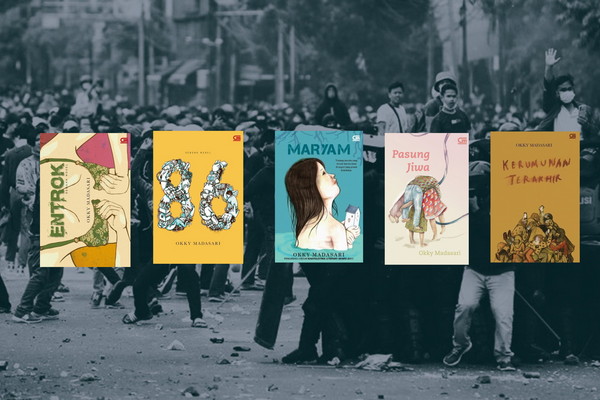
Taken together, her five major novels, from Entrok, 86, Maryam to Pasung Jiwa, and Kerumunan Terakhir, form perhaps the most coherent literary diagnosis of post-authoritarian Indonesia ever written.
These are not simply social novels. They are maps of power.
And read today, they feel disturbingly prophetic.
What makes Okky unusual is that she never treated Indonesia’s post-1998 democratic transition as a triumphant ending. While much of Indonesia’s intellectual and political class celebrated Reformasi as liberation, her novels consistently suggested something more unsettling: authoritarianism had not disappeared. It had merely changed form.
Each novel captures a different stage in that transformation.
In Entrok, widely considered her masterpiece, Okky reconstructs the psychological architecture of the New Order regime. The novel is set in rural Java and follows Marni, a poor woman trying to survive under military authoritarianism. But the true subject of the novel is not simply dictatorship. It is how fear becomes culture.
The military in Entrok is not distant state machinery. It enters kitchens, markets, bodies, sexuality, and religion. Extortion becomes routine. Obedience becomes survival. Violence becomes normalized. The regime does not merely rule society, it colonizes emotional life itself.
That is precisely why the novel feels so contemporary today.
As Prabowo restores military symbolism to the center of Indonesian political culture, Entrok reads less like historical fiction and more like an unfinished warning. The novel understood something many democratic reformers failed to grasp: authoritarianism survives not only through institutions, but through habits, desires, fears, and emotional dependency on order.
If Entrok explores militarized authoritarianism, then 86 examines what came after it: the bureaucratization of corruption.
Set in the police and legal system, 86 portrays a society in which corruption is no longer exceptional but procedural. Nobody needs to be ideologically evil. The system itself rewards compromise and punishes integrity. Everyone adapts because adaptation becomes necessary for survival.
This may be one of the most accurate portraits ever written about post-Reformasi Indonesia.
After 1998, democratic institutions expanded, but oligarchic structures remained intact. Corruption became decentralized, normalized, and embedded within administration itself. Under Prabowo, whose coalition includes many figures deeply tied to Indonesia’s old political and economic elite, that bureaucratic continuity has become even more visible.
Then came Maryam, perhaps Indonesia’s most important novel about religious majoritarianism.
Based loosely on the persecution of the Ahmadiyya community, the novel examines how democratic openness can produce new forms of social tyranny. In Maryam, coercion no longer comes mainly from the state. It comes from society itself: mobs, religious pressure, social exclusion, and moral policing.
The novel anticipated a transformation that would later define Indonesian politics: the rise of organized identity politics and the mainstreaming of religious intolerance.
Long before the massive Islamist mobilizations against Basuki Tjahaja Purnama in 2016, Okky already understood the fragility of Indonesian pluralism. She saw how citizenship itself could become conditional upon conformity.
That insight matters profoundly today as Prabowo governs through a broad coalition that includes conservative religious forces once hostile to democratic pluralism.
If Maryam examines social conformity, Pasung Jiwa turns inward, toward the colonization of identity itself.
This is arguably Okky’s most philosophically ambitious novel. Through questions of gender, sexuality, masculinity, and bodily control, the novel explores how societies discipline individuals emotionally and psychologically. The “pasung”, literally a shackle, becomes internal.
People police themselves.
The novel suggests that authoritarianism survives not merely through force but through internalized shame and social surveillance. Indonesia here is not only politically authoritarian; it becomes emotionally authoritarian.
This insight feels increasingly urgent in a society where public morality, nationalism, and conformity are becoming ever more intertwined.
Finally, Kerumunan Terakhir explores digital life, online identity, and the fragmentation of truth in the social media era.
In retrospect, the novel was astonishingly prescient.
It anticipated: online tribalism, algorithmic outrage, digital loneliness, manipulated narratives, and the collapse of meaningful public discourse.
Power no longer requires overt repression. Citizens voluntarily surrender themselves to spectacle, crowds, and emotional manipulation.
This may be Okky’s most contemporary insight of all.
Because Indonesia today is not simply experiencing democratic decline through military nostalgia or elite consolidation. It is also experiencing it through digital exhaustion: the erosion of attention, truth, memory, and critical thinking itself.
Read together, these five novels form a continuous anatomy of Indonesian power: from military domination, to bureaucratic corruption, to religious majoritarianism, to psychological discipline, to digital control.
Few writers anywhere have mapped political transformation with such consistency across multiple novels.
And perhaps even fewer have done so while remaining deeply readable.
Okky’s fiction matters because it refuses abstraction. Her novels are not ideological manifestos. They are grounded in ordinary lives: poor women, minorities, workers, queer individuals, lonely citizens, frightened families. Power is never theoretical. It is experienced through humiliation, fear, compromise, desire, and survival.
That human grounding gives her political insight unusual force.
Today, as Indonesia moves toward a more centralized and militarized political atmosphere under Prabowo, Okky’s novels increasingly resemble a literary archive of democratic erosion, not only how authoritarianism operates, but how societies emotionally adapt to it.
And that may ultimately be her greatest contribution.
She did not merely document Indonesia’s transition. She understood the structures beneath it.
