

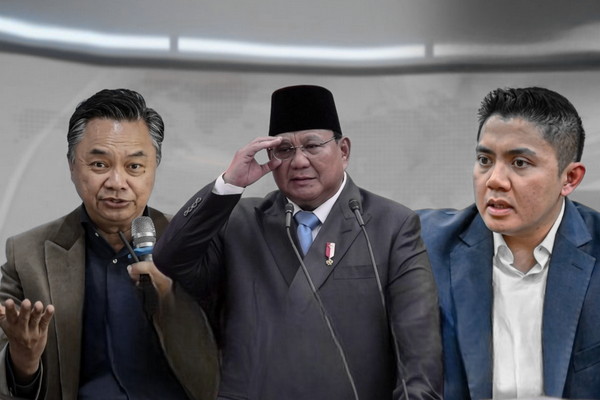
When Indonesian Cabinet Secretary Teddy Indra Wijaya recently responded to criticism of President Prabowo Subianto’s extensive overseas travel, he intended to defend the President’s diplomatic record. Instead, he may have revealed something far more significant: the growing personalization, or to be more specific, Prabowoization of Indonesian foreign policy.
The controversy began when veteran diplomat Dino Patti Djalal questioned the frequency of Prabowo’s foreign trips. According to Dino, the Indonesian President has become one of the world’s most travelled leaders, spending a remarkable portion of his first eighteen months in office abroad. Dino’s concern was not diplomacy itself. Rather, he questioned whether the scale, frequency, and cost of these visits were justified by their outcomes.
Teddy’s response was swift and comprehensive. He defended the President’s travel schedule by citing a long list of achievements: Indonesia’s accession to BRICS, a breakthrough in trade negotiations with the European Union, trillions of rupiah in investment, military modernization, successful Hajj management, support for Palestine, and the rescue of Indonesian citizens overseas.
At first glance, the response appeared persuasive. Yet a closer examination reveals that the debate is not really about travel. It is about something much larger: the increasing concentration of foreign policy around one individual.
Nearly every achievement Teddy cited was attributed directly or indirectly to Prabowo himself. Indonesia joined BRICS because of Prabowo. Investment flowed because of Prabowo. Trade agreements advanced because of Prabowo. The Hajj succeeded because of Prabowo. Palestine diplomacy succeeded because of Prabowo.
The implication was unmistakable. Indonesia’s foreign policy achievements were presented not as the product of diplomatic institutions, career diplomats, ambassadors, ministers, or long-term state capacity, but as the result of one man’s leadership.
This is not merely a communications strategy. It reflects a deeper transformation in how foreign policy is being imagined and practiced.
The most revealing example was Teddy’s invocation of investment figures. He pointed to approximately Rp 2.430 quadrillion in investment as evidence that Prabowo’s diplomacy is delivering tangible results.
The number is impressive. But what exactly does it prove?
Investment realization figures typically combine domestic investment, foreign investment, and reinvestment by companies already operating in the country. Even assuming the figure is accurate, it does not automatically demonstrate that the investment resulted from presidential diplomacy.
How much of the investment was foreign investment? How much represented genuinely new capital inflows? How much was the continuation of projects negotiated years earlier? How much resulted from commodity prices, industrial policy, domestic incentives, market demand, or Indonesia’s downstreaming strategy?
Most importantly, how much can reasonably be attributed to presidential visits abroad?
These questions remain unanswered.
The issue is not whether the investment figure is true. The issue is whether it proves what Teddy claims it proves.
This distinction matters because the government’s argument depends on a logical leap. National investment outcomes are being presented as evidence of the effectiveness of presidential travel. Correlation is being presented as causation.
The same pattern appears elsewhere.
Teddy cited Indonesia’s membership in BRICS as proof that the country’s fuel and food supplies remain secure and that subsidized fuel prices have not increased. Yet BRICS membership does not automatically guarantee energy security, food security, or price stability. Those outcomes depend on domestic fiscal policies, subsidies, reserves, global commodity markets, and supply chains.
Likewise, progress in negotiations with the European Union was presented as a triumph of Prabowo’s diplomacy. Yet these negotiations have been underway for more than a decade across multiple administrations. To credit the breakthrough primarily to the current President risks erasing the contributions of negotiators, diplomats, ministers, and previous governments.
The issue is not that Prabowo played no role. The issue is the tendency to attribute complex national achievements overwhelmingly to a single actor.
This tendency raises a more fundamental question.
Where are Indonesia’s diplomats in this story? Where is the Foreign Ministry? Where are the ambassadors who spend years cultivating relationships, building networks, and advancing Indonesia’s interests abroad?
Where are the trade negotiators who often dedicate a decade or more to securing agreements?
Where are the bureaucratic institutions designed to ensure continuity regardless of who occupies the presidential palace?
In Teddy’s narrative, these institutions largely disappear.
This is significant because diplomacy is, by its nature, an institutional enterprise.
Presidents matter. Foreign ministers matter. Personal relationships matter. But durable diplomacy depends on institutions. Professional diplomats provide continuity across administrations. Ministries preserve institutional memory. Ambassadors maintain relationships long after summit meetings end.
When diplomacy becomes excessively personalized, institutions inevitably become secondary.
This may be the most consequential implication of the current debate.
By concentrating diplomatic visibility, diplomatic credit, and diplomatic initiative in the presidency, Indonesia risks weakening the very institutions that make diplomacy effective and sustainable.
Ironically, Dino’s proposal that more responsibilities be delegated to Foreign Minister Sugiono was not merely a cost-saving suggestion. It was an institutional argument. It reflected a belief that diplomacy should not depend exclusively on presidential intervention.
The irony is that Teddy’s defense unintentionally reinforces Dino’s concern.
Every achievement cited by Teddy strengthens the image of Prabowo as Indonesia’s chief diplomat, chief negotiator, chief strategist, and chief problem solver. The President appears not as the leader of diplomatic institutions but as their substitute.
This raises another question rarely discussed in Indonesia.
If presidential diplomacy is as successful as the government claims, why does it appear so one-sided?
Prabowo has travelled extensively across the globe. Yet the number of foreign leaders making reciprocal visits to Jakarta appears very few.
Diplomacy is not measured only by how many countries a leader visits. It is also measured by how many leaders come to your capital. Influence flows in two directions.
A country that is becoming more diplomatically central should generate both outbound and inbound engagement. It should increasingly become a destination for diplomacy rather than merely a source of diplomatic travel.
This is not a criticism of Prabowo personally. It is a question about how diplomatic success should be measured.
Should success be measured by miles flown? By the number of summit photographs?
By the number of countries visited?
Or should it be measured by the strength of institutions, the durability of agreements, and the ability of a country to attract engagement from others?
The answers matter because the debate is ultimately not about travel.
It is about the nature of political power.
The personalization of foreign policy mirrors a broader tendency visible in contemporary Indonesian governance: the concentration of authority, visibility, and political credit in the presidency.
Achievements increasingly appear as presidential achievements. Policies increasingly appear as presidential policies. Institutions increasingly appear as extensions of presidential leadership.
Whether intentional or not, the cumulative effect is a re-centering of the state around the President himself.
The result is a paradox.
Prabowo’s supporters present this model as evidence of strong leadership. Yet strong states are not built merely through strong leaders. They are built through strong institutions capable of outlasting individual leaders.
Great powers do not become influential because their presidents travel constantly. They become influential because their institutions command respect, continuity, and trust.
Indonesia’s diplomatic future therefore depends on more than the energy and activism of one President. It depends on whether the country’s foreign policy remains institutionalized or becomes increasingly personalized.
The real question raised by the Teddy-Dino debate is not whether Prabowo travels too much. It is whether Indonesian diplomacy is becoming more effective through stronger institutions, or more dependent on a single individual.
That question will matter long after the current controversy fades.

