

As Malaysian Prime Minister Anwar Ibrahim sat down with President Prabowo Subianto this week, the contrast could not be clearer: Malaysia is still trusted to talk to everyone, while Indonesia is beginning to be treated with caution.
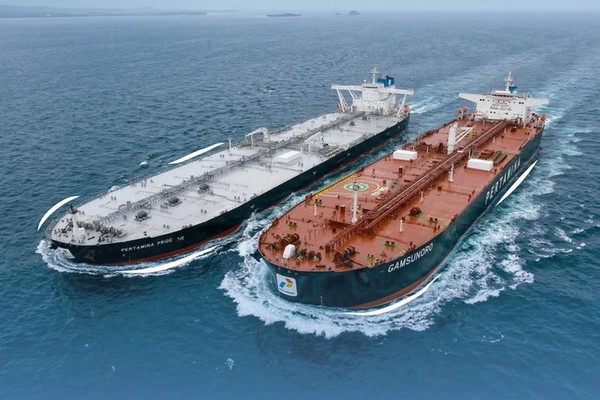
That shift does not arrive with fanfare. It reveals itself in quieter, more consequential ways, like the growing difficulty Indonesian tankers now face in passing through the Strait of Hormuz, even as vessels from neighboring countries continue to move.
Indonesia’s inability to move its ships through the Strait of Hormuz is not a minor diplomatic inconvenience. It threatens the flow of fuel that millions of Indonesians depend on for their daily lives.
This is not happening in normal times. It is unfolding in the middle of an escalating war involving the United States, Israel and Iran, where access to the Strait of Hormuz is no longer simply commercial, but deeply political. In such a context, shipping lanes become instruments of leverage. Passage is not only managed, it is granted, withheld, and differentiated.
Moments like this compress foreign policy into something tangible. What is often discussed in terms of principles and positioning becomes, suddenly, a question of access: who gets through, and who does not.
It would be simplistic to attribute Iran’s posture to a single cause. Decisions over passage through Hormuz are shaped by a mix of security calculations, commercial considerations and political signals. But it would be equally naïve to ignore what this episode reflects: a broader reassessment of Indonesia’s position, shaped by a series of recent choices.
For decades, Indonesia cultivated a form of diplomatic elasticity that allowed it to operate across geopolitical divides without being absorbed by any of them. It spoke forcefully on Palestine while maintaining relations with Iran. It engaged the United States without being defined by that relationship. It was not neutral in the sense of being silent, but independent in the sense of being trusted.
That trust is now under strain.
Part of the reason lies in the accumulation of signals that, taken together, make Indonesia harder to read. The decision to join the Board of Peace—an initiative closely associated with Donald Trump—is one such signal. Framed as a contribution to post-conflict stabilisation in Gaza, the initiative sits uneasily alongside established multilateral processes and is viewed with suspicion in parts of the Middle East.
Indonesia’s participation might have been intended as pragmatic engagement. But in international politics, participation is never neutral. It is interpreted. It is placed within a wider context.
That context includes earlier episodes: the 2023 seizure of the Iranian-flagged MT Arman 114 in the North Natuna Sea, alongside a series of diplomatic choices that, fairly or not, may be interpreted in Tehran as signalling greater distance between the two countries.
Perception, in this sense, becomes reality.
From Tehran’s perspective, Indonesia no longer appears as a country that instinctively keeps its distance from competing powers. It appears, instead, as one that is testing a closer proximity to Washington at a moment of heightened regional tension.
Whether or not that perception is fully accurate is beside the point. It shapes behaviour.
The Strait of Hormuz is where that behaviour becomes visible. In times of crisis, countries make distinctions, quietly, selectively, about whom they treat as neutral, whom they see as aligned, and whom they prioritise. Indonesia, at present, seems to fall into a more ambiguous category.
There is also a more immediate signal coming from Jakarta itself. President Prabowo does not appear to have an effective direct channel to the Iranian leadership, or, at least, not one he believes can quickly resolve the impasse. Rather than relying on high-level political engagement, he has instructed his energy minister, Bahlil Lahadalia, to secure alternative sources of oil as domestic supplies tighten.
That decision carries real consequences.
Sourcing oil elsewhere in the middle of a volatile conflict is neither quick nor cheap. It means entering a more competitive market, often at higher prices, with longer shipping routes and rising insurance costs. These pressures do not remain confined to contracts or state budgets. They ripple outward, into fuel prices, transportation costs and, ultimately, the cost of living.
For a country where energy remains central to daily economic life, this is not a marginal adjustment. It is a structural strain.
More importantly, it signals a shift in posture: from diplomacy to workaround. Instead of reopening political space, Indonesia is adjusting to its narrowing.
Malaysia offers a useful point of comparison. Under Anwar Ibrahim, it has maintained a relatively consistent posture: outspoken where necessary, but careful to preserve working relationships across divides. That consistency makes Malaysia legible to others. It is seen as predictable in its independence.
Indonesia’s recent trajectory is less clear.
There is a tendency in Jakarta to approach foreign policy as a series of discrete engagements: a security decision here, a diplomatic initiative there, an economic agreement elsewhere. But external actors do not read them separately. They connect them into a narrative about direction.
At present, that narrative is unsettled.
This carries costs. Not always dramatic, not always immediate, but cumulative. It narrows Indonesia’s room for manoeuvre. It complicates relationships that once felt straightforward. It introduces hesitation where there was once ease.
The difficulties in the Strait of Hormuz are one manifestation of that narrowing.
Even if access is eventually restored, something more intangible has shifted. Indonesia is being reassessed—not only by Iran, but by others watching how it positions itself in a more fragmented global order.
This is why the question of alignment matters.
Indonesia does not need to oppose the United States to maintain its independence. Nor does it need to disengage from initiatives that promise influence. But it does need to manage proximity with care. Too distant, and it risks irrelevance. Too close, and it risks being seen as predictable, or worse, as an extension.
The Board of Peace brings that tension into focus. It offers Indonesia visibility and a role in high-level discussions. But it also risks blurring the very distinction that has long given Indonesia its diplomatic value: the ability to engage without being subsumed.
That distinction cannot be maintained rhetorically. It must be reflected in choices.
Indonesia’s foreign policy has always depended less on material power than on positioning. It has relied on consistency, on the careful calibration of distance, and on the understanding that credibility is built slowly and can be eroded quickly.
What is at stake now is not a single shipping route, but that credibility.
The principle of bebas dan aktif was never about standing still. It was about moving freely, engaging widely without being constrained by alignment. Preserving that freedom requires discipline: the willingness to weigh not only the immediate benefits of a decision, but also the signals it sends.
Those signals are now being read more critically.
The meeting between Anwar Ibrahim and Prabowo Subianto is, in that sense, more than a bilateral encounter. It is a quiet illustration of two approaches to the same strategic environment, one that has so far preserved room to move, and one that risks narrowing it.
Indonesia still has time to recalibrate. Its position is not fixed. But recalibration begins with recognition: that in international relations, respect is not secured by proximity to power, but by clarity of purpose and consistency of stance.
Those are qualities Indonesia once embodied with confidence.
They are now being tested.

