

The government celebrates 5.6 percent economic growth. Officials speak confidently about resilience, optimism, and Indonesia’s bright future. Television graphics display upward curves. Ministers repeat the language of stability. International headlines describe Indonesia as one of the strongest economies in the developing world.
But outside official presentations and statistical reports, Indonesians are living a very different economy.
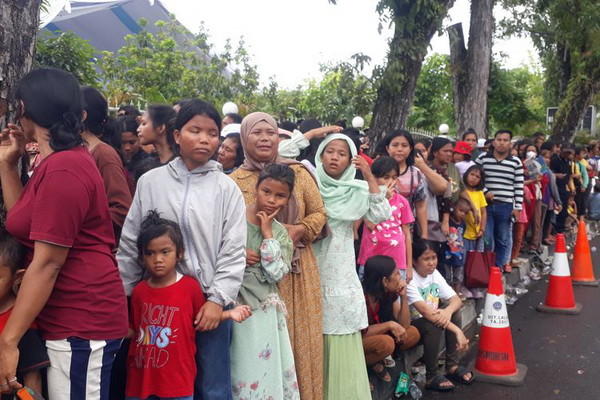
Young graduates send out hundreds of job applications without response. Workers with university degrees accept unstable freelance work with no protection or future. Middle-class families survive through debt while food, housing, education, and transportation costs continue rising faster than salaries. Social media is flooded with anxiety, exhaustion, and the now-famous phrase “kabur aja dulu,” reflecting a generation increasingly convinced that the future may lie outside the country rather than within it.
The contradiction is becoming impossible to ignore: if the economy is growing so strongly, why do so many Indonesians feel increasingly insecure?
This is the central political and sociological question Indonesia must confront today. The issue is not merely whether GDP figures are technically correct. The deeper issue is what those numbers conceal, who actually benefits from growth, and how economic statistics are used politically to manufacture perceptions of success amid worsening social realities.
According to official data from BPS (Statistics Indonesia), Indonesia’s economy grew 5.61 percent year-on-year in the first quarter of 2026. But the same data also showed that one of the biggest drivers of growth was government consumption, which surged by more than 21 percent. Much of this was linked to state spending, seasonal Ramadan and Eid consumption, social assistance, civil servant bonuses, and the government’s flagship Free Nutritious Meals program.
This matters because not all growth is equal.
An economy driven primarily by productive industrial transformation creates sustainable jobs, technological development, rising wages, and stronger domestic production. But an economy increasingly dependent on state spending, commodity extraction, imports, and politically connected procurement networks creates a very different reality: fragile growth without deep prosperity.
And this is precisely what Indonesia increasingly resembles.
For years, Indonesia has experienced gradual deindustrialization. Manufacturing’s contribution to GDP has steadily declined compared to earlier decades. Instead of building a strong industrial base capable of producing high-value goods, Indonesia remains heavily dependent on raw commodity exports, extractive industries, imports, and consumption. Coal, nickel, palm oil, and mineral extraction dominate economic narratives, while domestic manufacturing capacity struggles to compete with imported products flooding local markets.
This is not merely an economic issue. It is a structural political problem.
Extractive economies historically generate concentrated wealth rather than broad prosperity. They enrich oligarchic networks, political intermediaries, contractors, and resource elites while leaving large sections of society trapped in precarious employment and low wages. Such economies produce inequality not accidentally, but structurally.
Indonesia’s current trajectory increasingly reflects what political economists describe as a rentier tendency, an economy where wealth is generated less through productive innovation and more through access to state power, permits, contracts, concessions, and political proximity.
This is visible even within many government programs presented as pro-people initiatives.
Programs such as the Free Nutritious Meals initiative are promoted as solutions for public welfare and child nutrition. But the critical question is not simply whether assistance reaches the public. The deeper question is: who captures the largest economic benefits within the system surrounding these programs?
In practice, large-scale state projects often create layers of procurement networks, logistics contracts, suppliers, consultants, brokers, and politically connected intermediaries. Public money circulates upward through elite networks long before limited benefits trickle downward to ordinary citizens. The people receive symbolic relief; those already possessing capital and political access capture structural advantage.
This is classic rent-seeking political economy.
Meanwhile, the economy experienced by ordinary Indonesians continues deteriorating in crucial ways.
Youth unemployment and underemployment remain serious concerns. Informal work dominates much of the labor market. Many Indonesians technically counted as “employed” survive through unstable gig work, online selling, short-term contracts, or multiple low-income activities that provide neither security nor upward mobility. Official unemployment statistics often fail to capture this deeper precarity.
Purchasing power also remains fragile. While official inflation figures may appear manageable, lived inflation, particularly for food, housing, education, transportation, and urban survival, feels far more severe to ordinary households. Economic anxiety becomes social psychology long before it appears in macroeconomic indicators.
This is why GDP alone cannot explain social reality.
A country can record impressive growth while simultaneously producing widespread insecurity, inequality, and despair. Political sociologist Karl Polanyi warned decades ago that societies become unstable when economic systems detach from social realities and human needs. Similarly, Antonio Gramsci argued that political power is maintained not only through coercion but through the manufacture of consent, including narratives that persuade citizens to accept contradictions between official claims and lived experience.
Today, economic optimism itself increasingly functions as political narrative.
The state selectively amplifies headline indicators such as GDP growth, investment announcements, or infrastructure expansion while minimizing discussion of rupiah weakness, stagnant wages, deindustrialization, rising debt burdens, or declining middle-class security. Social media campaigns, official infographics, and patriotic economic rhetoric create what French theorist Jean Baudrillard described as simulacra: representations that begin replacing reality itself.
Indonesia increasingly risks becoming an economy of spectacle.
Mega-projects become symbols of progress regardless of their actual social returns. Growth statistics become instruments of legitimacy. Nationalism becomes intertwined with economic branding. The image of prosperity becomes politically more important than prosperity itself.
Yet financial markets often reveal contradictions more honestly than political speeches.
Despite official optimism and reported foreign inflows, the rupiah has experienced severe pressure. Bank Indonesia has repeatedly intervened aggressively to stabilize the currency. This matters because currencies reflect not only present conditions but future confidence. A weakening rupiah amid triumphant growth narratives exposes underlying fragility that official statistics alone cannot conceal.
The danger is not merely economic but also political.
History repeatedly shows that prolonged economic insecurity combined with widening inequality creates fertile ground for authoritarian tendencies, emotional nationalism, and increasingly centralized power. When material realities worsen, governments often rely more heavily on spectacle, symbolism, militaristic rhetoric, and emotional mobilization to maintain legitimacy. Economic narratives then become political instruments rather than tools for honest public understanding.
Indonesia today stands at precisely this crossroads.
The question is no longer whether the government can produce favorable quarterly statistics. The deeper question is whether Indonesia can build an economy that genuinely produces dignity, stability, meaningful work, technological progress, and broad social mobility for the majority of its people.
Because eventually citizens compare official optimism with lived reality.
And no society can permanently survive on spectacle alone.

