

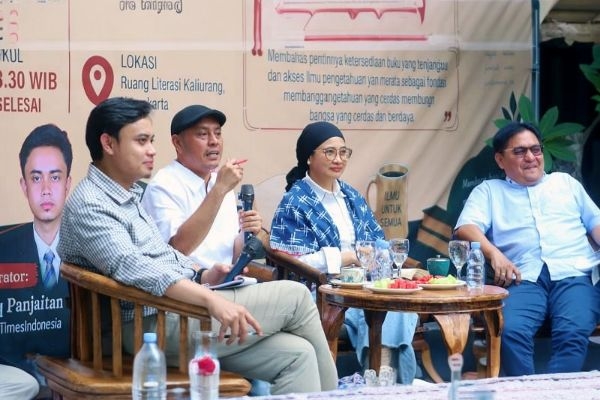
Yogyakarta’s afternoon sun was still bright and golden as the discussion about the book bill, literacy, and how best to improve the country’s reading habit this Thursday at the newly established Ruang Literasi Kaliurang building in Sleman, was getting heated, with dozens of people glued to their seats, listening to the three speakers on the stage, while alternatingly asking questions.
Meet Willy Aditya, the owner of the building dedicated to creating a space for people to read books and discuss various issues.
Willy is a legislator from the NasDem Party. But he is not just another legislator; he is the head of Commission XIII overseeing human rights. For people in Sleman, it is a rarity to directly listen to a legislator from Jakarta speaking, let alone discussing his dream about giving access to as many people to books and knowledge.
“Books are about building our civilization. If food is for our body to survive, books are for our brain. We can’t prioritize one over the other. How can we compete if we don’t read,” he told the audience. But every time people clapped for him, he lowered his head in embarrassment as if he knew he was not that good. As a politician, of course, he has done many compromises, considering how brutal and corrupt the legislators are. But modesty and his moral compass as a Muslim learning directly under the great A.A. Navis, one of the nation’s biggest writers and thinkers, are really stuck on him.
In a political landscape where lawmakers are often associated with wealth accumulation and transactional power, Willy represents a rare breed. He has chosen to funnel his own time, money, and political capital back into the foundational bedrock of society: literacy. While others build political empires, he builds sanctuaries for the mind like Ruang Literasi Kaliurang.
But his most grueling battle is being fought away from this peaceful mountain air, back in the clinical, high-stakes corridors of the Badan Legislasi (Baleg) in Jakarta. There, Willy is fighting an almost singlehanded crusade to pass the Book System Bill (RUU Sistem Perbukuan).
The crisis he is trying to fix is structural, urgent, and backed by terrifying data. The state of Indonesia’s intellectual capacity is currently flashing red on the global stage. In the global Pisa Metrics, Indonesian 15-year-olds scored an abysmal 359 in reading, 366 in mathematics, and 383 in science. To understand how catastrophic these figures are, they sit roughly more than 100 points below the international OECD average. In the framework of global education metrics, a 100-point deficit is equivalent to a child missing multiple whole years of standard schooling.
The results place Indonesia near the absolute rock bottom of international rankings, sitting at a dismal 71st in reading, 70th in mathematics, and 67th out of 81 countries and territories assessed. More than 60 percent of the nation’s students fail to pass Level 1, the bare minimum threshold for basic proficiency. This means the vast majority of Indonesian youth are functionally unable to distinguish facts from opinions, interpret basic tables, or execute foundational calculations needed for daily life. It is a generational decay triggered directly by the structural collapse of reading habits, reflected in the recent, painful wave of closures striking down legacy bookstore chains like Toko Buku Gunung Agung and regional independent publishers.
Yet, the state’s financial compass continues to steer heavily away from the mind. While Willy is left to beg for scraps to fund public libraries, the state readily mobilizes astronomical funds for populist, tangible infrastructure. The government has aggressively committed hundreds of trillions toward massive logistics portfolios, headlined by the colossal Rp 268 trillion earmarked for the Makan Bergizi Gratis (MBG) program, alongside vast capital injections flowing into bureaucratic expansions like the newly minted Red and White Cooperatives.
In the grand ledger of Indonesian governance, physical feeding tubes and institutional signaling receive immediate, blank-check priorities. Meanwhile, structural investments toward teaching children how to think, analyze, and read are treated as minor arithmetic afterthoughts.
The current system remains deeply flawed: while the government heavily subsidizes school textbooks, general literature and non-textbooks are completely abandoned to the harsh whims of the free market. High production costs and distribution bottlenecks mean that standard books have become an unattainable luxury for the average citizen. Meanwhile, local governments spend lavishly on self-promoting advertisement budgets while assigning embarrassingly low amounts for public libraries, leaving them starved for fresh content.
Willy’s bill aims to change all of this by overhauling the entire ecosystem, including a radical proposal to slash the tax rate for authors from 1.5 percent down to a flat zero percent to keep local writers alive.
Yet, the biggest hurdle Willy faces isn’t the publishing industry; it is the fundamental indifference of his fellow legislators. In a House of Representatives driven heavily by transactional politics, bills that move forward are usually those that promise tangible, lucrative political kickbacks or immediate rewards for powerful corporate lobbies. A bill meant to lower book prices and democratize critical thinking offers no such financial or political compensation to indifferent politicians.
Because the RUU Sistem Perbukuan lacks the commercial lubrication of corporate-backed laws, Willy finds himself operating on an isolated legislative island. He has successfully pushed the bill into the 2026 Prolegnas Prioritas (National Legislation Program), but keeping it from getting permanently stuck in the House requires constant, exhausting personal momentum.
Whether or not he can overcome this brutal current, Willy is a testament that Indonesian politics can still produce a sincere politician who remains deeply pragmatic and realistic. He is under no illusions about the system he operates in. He fully realizes his place as a petugas partai (party servant) and is acutely aware of the deeply entrenched, powerful elites surrounding him. Yet, those towering political constraints do not prevent him from pushing for something genuinely beneficial to the nation.
Willy probably knows he is not that good, but at least he continues to do exactly what a legislator is supposed to be doing, one step at a time, one draft bill at a time. Under the country’s current confusing and corrupt conditions, where public trust in parliament is at an all-time low, the nation desperately needs more legislators like Willy. As the sun dipped lower over Sleman, his message remained clear: you cannot build a lasting, critical democracy unless the state finally acknowledges that books are the fundamental food for the nation’s brain.
