

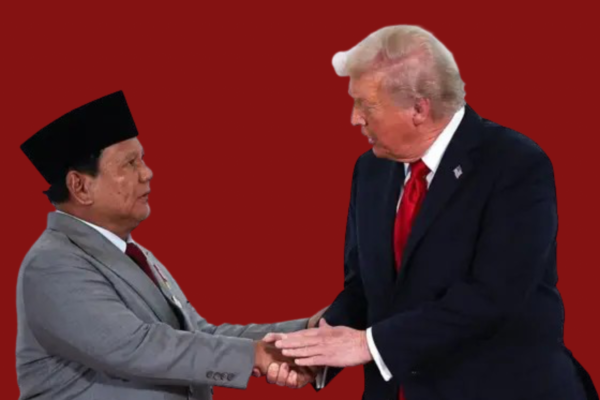
If Louis XIV of France once personified his country with the legendary claim “L’État, c’est moi”, or “I am the state”, then everything President Prabowo Subianto has done on the international stage seems to echo a similar assertion: “I am Indonesia.”
His first year in office have shown how deeply he has personalized Indonesia’s foreign policy, turning what was once a collective and deliberative process into a series of gestures driven by instinct, emotion, and self-image.
Unlike his predecessor, Joko Widodo, who appeared indifferent to foreign affairs and happy to delegate them to ministers or special envoys, Prabowo is visibly captivated by the theater of diplomacy. He loves the stage: the flags, the cameras, the handshakes. But behind this theatricality lies something more serious and troubling: the consolidation of foreign policy into the hands of a single man who listens to no one and consults almost nobody.
Prabowo’s approach appears to leave little room for professional diplomats, experts, or institutional advice. His decisions often seem sudden, uncoordinated, and driven by personal conviction rather than long-term strategy. What used to be Indonesia’s greatest diplomatic strength: its patience, its moral posture, its ability to mediate, is now being replaced by displays of personal bravado and unpredictability. In his hands, Indonesia’s foreign policy is no longer an orchestra of institutions but a solo performance.
Under Joko Widodo, Indonesia’s Ministry of Foreign Affairs had already suffered a blow. Jokowi reduced the country’s diplomacy to a matter of salesmanship, frequently reminding ambassadors that their primary duty was to “sell the country,” attract investors, and open markets. Diplomats were turned into marketers; embassies became trade promotion offices. The language of diplomacy was replaced by that of commerce.
Prabowo, however, has gone even further. If Jokowi belittled the ministry, Prabowo has begun to suffocate it. The Foreign Ministry no longer dares to propose ideas, initiatives, or alternative views. Its officials, once known for their analytical independence and strategic thinking, now operate under an atmosphere of fear and uncertainty. Everything depends on what Prabowo wants, says, or feels. No one dares to disagree. The result is paralysis, not because there is no capacity, but because there is no permission to use it.
One of the clearest examples came earlier this month, when Prabowo suddenly decided to attend a Trump-led “peace talk” on Gaza in Sharm el-Sheikh, Egypt. The announcement caught Indonesia’s diplomats completely off guard. Soon after, several international media outlets reported that Prabowo was expected to visit Tel Aviv to meet Donald Trump and Benjamin Netanyahu as part of discussions surrounding a revived Abraham Accord framework. The Ministry of Foreign Affairs, blindsided by the reports, was forced to respond hastily, telling journalists that “there is no plan”, an unusually candid admission that the ministry had not been informed, let alone consulted.
Another clear incident to illustrate Prabowo’s personal and impulsive approach was when he was recorded in a hot-mic moment discussing personal meetings with members of the Trump family during a tense diplomatic session in the same Gaza talks in Sharm el-Sheikh. While the substance of the conversation was not necessary scandalous, the optics revealed how personal entanglements can overshadow state purpose. A summit intended to address war and humanitarian catastrophe became a stage for interpersonal rapport.
The episodes laid bare how foreign policy decisions are now concentrated entirely in the president’s hands. What used to be coordinated, deliberated, and carefully calibrated now unfolds as a series of personal gestures: bold, impulsive, and unpredictable, leaving Indonesia’s own diplomatic machinery scrambling to catch up. For the ministry, it was a humiliating moment: once the brain of Indonesia’s international thinking, now reduced to confirming or denying the president’s improvisations.
The weakening of the Foreign Ministry has also been institutionalized through Prabowo’s appointment of Sugiono, an ex-Army lieutenant and one of his closest confidants, as Foreign Minister. Sugiono is an outsider to diplomacy, with no background in the ministry and little experience in international negotiation. His selection marked a decisive break from Indonesia’s long tradition of entrusting foreign affairs to career diplomats or technocrats with deep institutional memory. Since his appointment, Sugiono has shown little initiative beyond following whatever Prabowo wants. His role seems less that of a minister and more of a personal aide, ensuring the president’s foreign policy preferences are implemented without question.
This arrangement effectively severs the communication line between professional diplomats and the president. The flow of analysis, recommendations, and dissenting views that once defined the ministry’s relationship with the palace has all but disappeared. What remains is a one-way transmission, from Prabowo’s office outward. In this structure, the Foreign Ministry no longer shapes policy; it merely translates the president’s moods into official statements.
The consequences go far beyond bureaucratic dysfunction. Indonesia’s foreign policy, once seen as a moral compass for Southeast Asia, risks losing its credibility and coherence. The country that prided itself on free and active diplomacy, balancing relations between major powers, standing firm for Palestine, and leading ASEAN through consensus, now looks increasingly like a state guided by personal projection. Prabowo’s overt friendliness toward Donald Trump, his fascination with military imagery, and his habit of inserting himself into global crises may make headlines, but they do little to strengthen Indonesia’s long-term diplomatic capital.
Diplomacy is not only about appearances. It is about process, continuity, and trust. When a country’s foreign policy becomes the expression of one person’s ego, it erodes all three. Allies grow uncertain; partners grow cautious. And within the state, institutions begin to atrophy. Seasoned diplomats, uncertain of their roles, retreat into silence. Younger officers, once eager to innovate, learn that initiative can be dangerous. Over time, the entire machinery of diplomacy becomes ornamental, existing to legitimize decisions already made elsewhere.
This personalization of foreign policy also weakens Indonesia’s role within ASEAN. The region’s effectiveness depends on member states acting with consistency and institutional discipline. Prabowo’s unpredictable gestures, however, inject confusion and distrust into ASEAN’s collective diplomacy. When Indonesia, traditionally the grouping’s stabilizing force, begins to speak with a single man’s voice, ASEAN’s centrality itself is put at risk.
The irony is that Prabowo, like Louis XVI, may see this personalization as strength. He may believe that embodying Indonesia gives him greater authority, that acting boldly signals leadership. But in diplomacy, power without process is fragility in disguise. The very institutions he sidelines are the ones that safeguard the state from the whims of its leaders. Without them, even the strongest personality becomes isolated, reactive, and easily manipulated by foreign powers eager to flatter or exploit personal ties.
Indonesia’s foreign policy now can either remain a projection of one man’s will or reclaim its institutional integrity. The difference will determine not only how the world sees Indonesia but also how Indonesians understand the state itself. Prabowo’s claim of “I am Indonesia” may resonate with nationalist pride, but it is a dangerous illusion. The state is not a person, and no leader, however charismatic or confident, can replace the collective wisdom of institutions built over decades.
If Indonesia’s diplomats are silenced, its strategic depth will fade. If its foreign policy becomes a personal stage, its international respect will erode. Prabowo may have won the presidency, but he has yet to show he can govern a nation larger than himself. For now, every sign suggests that Indonesia’s foreign policy is no longer the voice of a republic, but the echo of a single man.

