

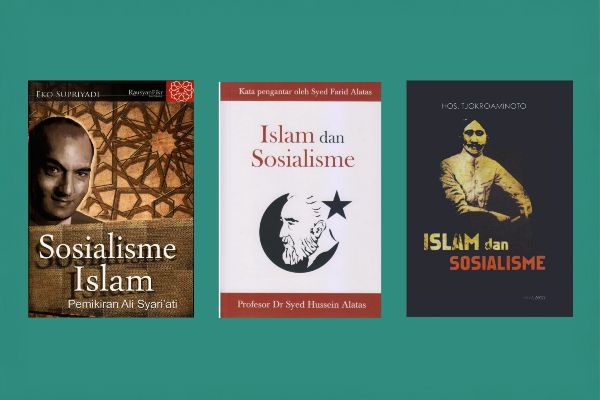
It was a hot November evening in what was supposed to be the rainy season in Yogyakarta. Young people flocked to the parking lot of Bentang Pustaka, a publishing house belonging to the Mizan Group. The rain was holding off, much to the relief of the publisher and the young Indonesians who had gathered to listen to speakers discussing books by Iranian socialist thinker Ali Shariati, recently republished in Indonesian.
This was neither an isolated event nor a discussion confined to Shariati. Over the past two years, young Indonesians have increasingly turned to the writings of Tan Malaka, Indonesia’s revolutionary socialist thinker and independence fighter. His ideas, alongside those of other socialist thinkers, have found new audiences among a generation searching for answers to inequality, economic concentration and a political system that appears increasingly distant from their everyday concerns.
The renewed interest in socialism is becoming increasingly visible in Indonesia. But something else is happening alongside it. The very language of socialism that young Indonesians are rediscovering is being appropriated by the ruling establishment, including President Prabowo Subianto’s own government.
Prabowo’s associates are now working to give his signature programmes, particularly the Free Nutritious Meals (MBG) and Red and White Village Cooperatives (Kopdes Merah Putih), an ideological and historical foundation. What began as campaign promises and flagship government programmes is being elevated into a supposedly distinct economic philosophy, presented as a revival of Indonesia’s tradition of economic democracy and people’s economy.
The effort has become increasingly explicit. On March 5, a seminar at the Bandung Institute of Technology (ITB), attended by Deputy House Speaker Sufmi Dasco Ahmad and several cabinet ministers, introduced the concept of Prabowonomics through the launch of a book by Syahganda Nainggolan, a political associate of the president. Cooperative Minister Ferry Juliantono described Kopdes Merah Putih as a concrete manifestation of Prabowonomics, intended to reverse what he called Indonesia’s excessively liberal and capitalist economic direction.
The political ambition behind this ideological packaging became even clearer last week. Syahganda, now head of the government’s Communication Agency, declared that the village cooperative programme was part of Prabowo’s effort to transform Indonesia’s economic paradigm from serakahnomics, or an economy serving the greed of a few, into a people’s economy based on cooperatives. He explicitly described this as a departure from free-market capitalism and neoliberalism.
There is nothing wrong with debating socialism or seeking alternatives to an economic system that has produced deep inequalities. Nor is there anything wrong with the government invoking economic justice to justify public programmes. The problem begins when political branding is passed off as an economic philosophy, and when programmes that have yet to demonstrate their promises are presented as the fulfilment of a historical ideal.
But sorry, Pak Prabowo, MBG and Kopdes Merah Putih are not socialism.
The distinction is not merely semantic. Socialism, in its many intellectual traditions, concerns the organisation and distribution of economic power, ownership and control over productive resources. It is not simply a larger government, a bigger public budget or a collection of state-sponsored welfare programmes. A government can intervene extensively in the economy without challenging the concentration of wealth and power. Indeed, state intervention can create new opportunities for private accumulation, political patronage and rent extraction.
MBG illustrates the problem. Feeding children nutritious meals is a legitimate social responsibility of the state. No serious person should oppose the objective of ensuring that children from poor families receive adequate nutrition. But the social purpose of a programme does not determine its economic character. We must look at how it operates, who controls its resources, who receives its contracts and who benefits from the enormous public expenditure involved.
The corruption investigation into the National Nutrition Agency (BGN) should make this question impossible to ignore. The Attorney General’s Office has named multiple suspects in investigations into alleged irregularities in the programme’s management and procurement, including alleged conflicts of interest involving affiliated foundations and mark-ups in the procurement of goods. In October, prosecutors also named five suspects in a separate investigation into the procurement of electric motorcycles worth approximately Rp1.22 trillion.
These are allegations under investigation, not grounds for declaring every aspect of MBG corrupt. But they expose precisely why the programme must be judged by its institutional arrangements rather than its declared intentions. A programme designed to serve millions of children should not become an avenue for privileged access to public money.
The same question applies to Kopdes Merah Putih. Indonesia has a rich tradition of cooperativism, most notably associated with Mohammad Hatta. But Hatta’s cooperative vision was never simply about building cooperative offices, distributing government funding or placing village economic activities under a centrally designed programme.
For Hatta, cooperatives were instruments of economic democracy. They were meant to empower ordinary people through collective ownership, democratic participation and control over their own economic affairs. Cooperatives were supposed to grow from people’s needs and initiatives, not merely exist because the government had decided to establish them.
There is a fundamental difference between a cooperative owned and governed by its members and an institution whose direction, financing and economic priorities are largely determined from above. The establishment of thousands of cooperatives does not automatically create a cooperative economy. Nor does attaching the name of Hatta to a government programme make it an expression of his economic thinking.
The contradiction becomes even more striking when we consider Prabowo’s own earlier account of his economic philosophy. In his 2023 book, Strategi Transformasi Bangsa, he argued that pure socialism was impractical and that Indonesia should instead adopt a mixed economy, drawing on the strengths of both capitalism and socialism. He invoked his father, economist Sumitro Djojohadikusumo, and the economic thinking of the country’s founding leaders.
There is nothing inherently contradictory about advocating a mixed economy. But it raises a question: why is socialism now being invoked so prominently to legitimise programmes that are, at best, instruments of state-led economic intervention? Is this a genuine evolution in Prabowo’s economic thinking, or an attempt to give politically vulnerable programmes a more persuasive ideological identity?
The historical comparison with Hatta makes the problem even more apparent. Economic democracy cannot be measured by how many cooperatives the state establishes, but by how much economic power ordinary people actually acquire. The test is not the number of buildings, the size of government allocations or the frequency with which officials invoke the people’s economy. It is whether people have meaningful ownership, control and a voice in economic decisions.
There is also a political reason to be wary of this sudden ideological enthusiasm. Both MBG and Kopdes have faced mounting criticism over implementation, financing, accountability and the distribution of economic opportunities. The corruption investigations surrounding MBG have further damaged the government’s claim that these programmes are straightforward instruments of public welfare. Giving them a socialist pedigree offers a convenient way to shift the debate from performance and accountability to ideology and historical legitimacy.
It also risks turning criticism of government programmes into an apparent rejection of social justice itself. Anyone questioning MBG can be portrayed as opposing the feeding of children; anyone questioning Kopdes can be accused of rejecting the empowerment of rural communities. Now, critics may also find themselves positioned against the very idea of a people’s economy.
This is precisely why the distinction matters. Socialism should not become a political shield for programmes that must remain open to public scrutiny.
The young Indonesians gathering to read Shariati and Tan Malaka are looking for ideas to understand and challenge the structures that produce inequality and concentrate power. They deserve an honest intellectual debate, not an official narrative that appropriates the language of emancipation to defend government programmes.
If Prabowo wants to invoke Hatta, he should begin with Hatta’s commitment to economic democracy. If he wants to speak of socialism, he should explain how his policies redistribute economic power rather than simply expand the state’s role in managing public resources.
The people do not need a government to tell them that its programmes are socialist. They need institutions that give them greater control over their economic lives.
Socialism is not a label to be attached to a presidential programme. It is a question of who owns, who controls and who benefits. On that test, Mr. President, MBG and Kopdes still have a long way to go.
