

If your president’s interest is only how to survive and get re-elected in the following election, he will avoid risk and try to find the easy way, rather than reforming state institutions that have long been exposed as deeply corrupt.
Instead of dismantling entrenched patronage networks, he will manage them. Instead of confronting competing centres of power, he will balance them. Instead of strengthening institutions, he will seek short-term political stability. The result is not a strong presidency, but a weak one.
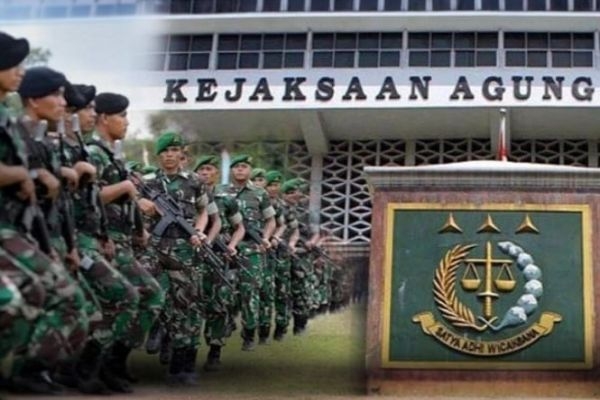
The escalating confrontation between Indonesia’s National Police (Polri), the Attorney General’s Office (AGO), and the unprecedented involvement of the military (TNI) is a window into the character of Prabowo Subianto presidency, much more than an institutional dispute. The crisis reveals not only the weakness of Indonesia’s law-enforcement institutions but also the limits of presidential power in a political system dominated by competing elite networks.
A genuinely strong president would seize such a crisis as an opportunity to undertake long-overdue institutional reform. He would establish an independent investigation, reinforce civilian supremacy, restore public confidence in the rule of law, and ensure that no institution is above accountability. He would root out the underlying structural problems.
Instead, Prabowo only called for restraint and self-reflection to institution battling for power and resources. It’s like begging a hungry lion not to eat you. It will eat you anyway.
As a result, these institutions continue to confront one another, and the system that produced the confrontation survives intact.
This is the defining feature of a weak presidency. Weakness should not be confused with a lack of authority or an inability to command public attention. A president, like Prabowo, may possess enormous constitutional powers, enjoy a comfortable parliamentary majority, and project the image of a decisive nationalist leader. Yet he remains weak if he lacks either the willingness or the political freedom to reform the institutions that sustain his own power.
The explanation lies partly in the nature of Indonesia’s governing coalition. Prabowo did not enter office as the uncontested leader of a new political order. He inherited a broad coalition that includes many of the political and economic forces that shaped the previous administration. Maintaining such a coalition inevitably requires compromise. Every major reform risks alienating influential partners whose support is necessary to preserve political stability.
The continuing influence of former president Joko Widodo further complicates this political landscape. Although no longer in office, Jokowi remains an important actor through his extensive political networks, senior officials who continue to occupy strategic positions, and the presence of his son,Vice President Gibran Rakabuming Raka, within the executive. The 2024 election did not produce a complete transfer of political power from one administration to another. Instead, it produced a hybrid government in which elements of continuity coexist with Prabowo’s own political agenda.
This hybrid arrangement narrows the room for decisive institutional reform. A far-reaching restructuring of the police, prosecution service, or broader security apparatus would inevitably affect networks of influence that predate the current administration. Whether these networks are associated with Jokowi, Prabowo, political parties, or powerful business interests, they represent entrenched centres of power that no president can confront without paying a significant political price.
The confrontation between the Police, the Attorney General’s Office, and the military illustrates precisely this problem. Rather than functioning as professional institutions operating within clearly defined constitutional boundaries, they increasingly appear as competing centres of authority whose conflicts require presidential mediation rather than institutional resolution. Such a system is inherently unstable. It depends not on strong institutions but on continuous political bargaining among powerful elites.
This explains why institutional reform is repeatedly postponed. Reform creates losers. It disrupts patronage networks, threatens political alliances, and exposes long-protected interests. A president primarily concerned with preserving his governing coalition will naturally prefer accommodation to confrontation. Managing institutional rivalry becomes politically safer than eliminating its underlying causes.
The consequences extend well beyond the immediate crisis. Citizens lose confidence in the impartiality of law enforcement. Public institutions become identified with competing political factions rather than constitutional mandates. Democratic accountability weakens as informal political negotiations replace transparent institutional governance. In the long run, the state becomes less capable of governing because its institutions serve political survival rather than the public interest.
History demonstrates that genuine political leadership requires accepting short-term risks for long-term institutional gains. Democratic reform has never been achieved by preserving every existing alliance. It has required leaders willing to expend political capital in order to strengthen institutions beyond their own presidency.
Indonesia’s current institutional crisis therefore poses a larger question than whether the Police, the Attorney General’s Office, or the military will prevail in their latest confrontation. The more fundamental question is whether the presidency itself remains capable of undertaking reforms that inevitably threaten the political coalition upon which it depends.
A president who governs by constantly balancing competing elites may survive politically. He may even enjoy high approval ratings and maintain parliamentary dominance. But survival should never be mistaken for strength. A presidency that cannot reform the institutions it commands is, by definition, a weak presidency.
Ultimately, the measure of presidential strength is not how effectively a leader manages elite rivalries. It is whether he leaves behind institutions that no longer depend upon presidential intervention to function. Until Indonesia’s leaders are prepared to prioritise institutional transformation over political survival, the country will continue to witness recurring conflicts among powerful state institutions while the deeper architecture of dysfunction remains untouched.


